

Blog > Cupertino, Palo Alto, and Los Altos School Assignments: Three Systems Buyers Should Understand Before Purchasing
Cupertino, Palo Alto, and Los Altos School Assignments: Three Systems Buyers Should Understand Before Purchasing
by
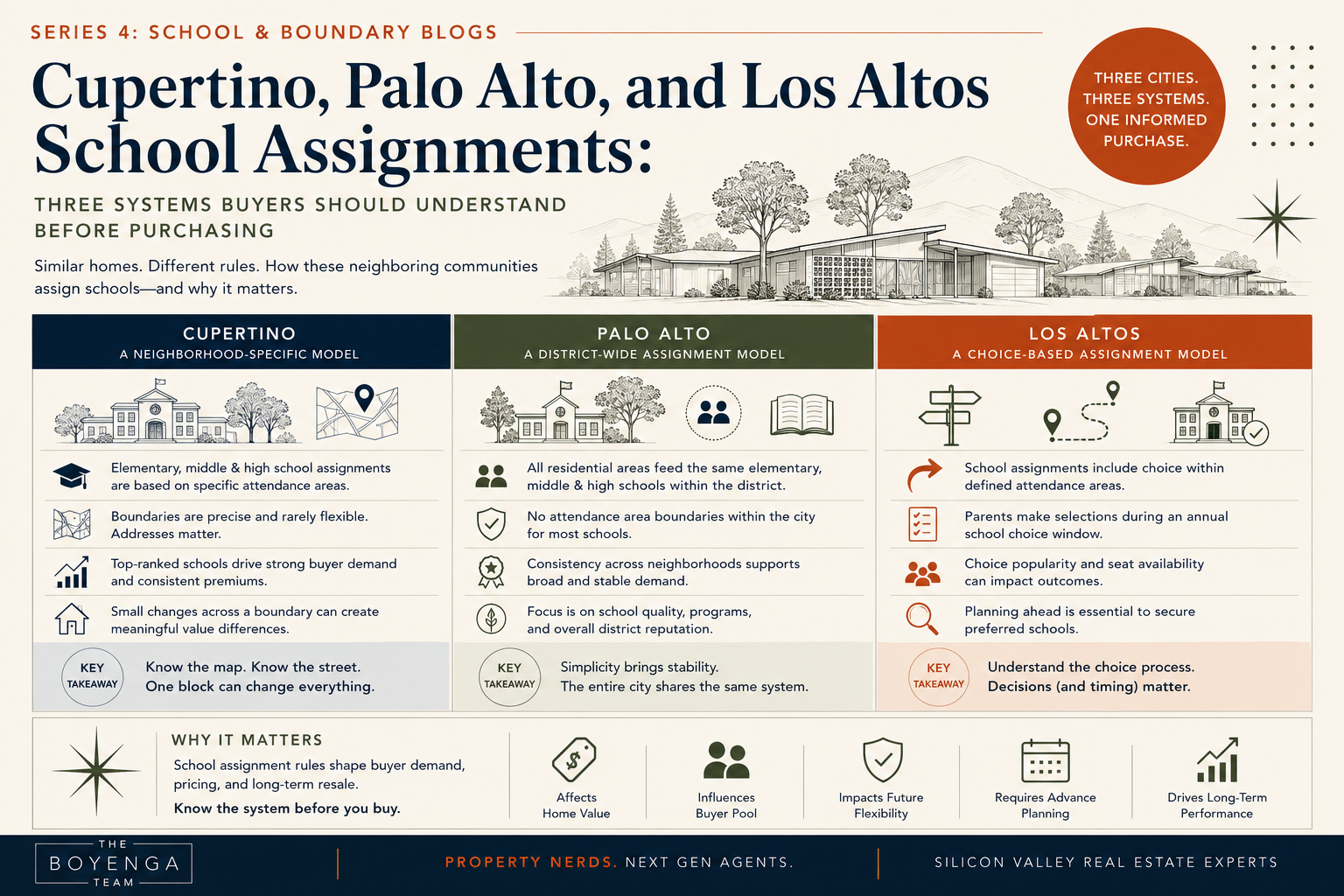 Few topics create more confusion among Silicon Valley homebuyers than school assignments.
Buyers often assume that purchasing a home within a particular city automatically determines which schools serve the home. In reality, neighboring communities can follow dramatically different assignment models. Two homes with similar architecture, comparable prices, and identical commute times may operate under entirely different enrollment systems simply because they sit in different school districts.
Understanding those systems before making an offer is just as important as understanding the home itself.
School assignments influence not only daily life but also future buyer demand, resale liquidity, and long-term market performance. They are one of the reasons Silicon Valley neighborhoods behave so differently despite their geographic proximity.
The Boyenga Team frequently analyzes these relationships between schools, neighborhoods, and buyer behavior throughout Silicon Valley at https://boyengarealestateteam.com, helping buyers evaluate communities through a broader ownership lens rather than relying solely on school assignments.
Similar Homes, Different Rules
One of the most surprising discoveries for many buyers is that there is no universal approach to school assignments across Silicon Valley.
Some districts assign schools almost entirely by residential address. Others maintain district-wide enrollment systems where neighborhood boundaries play a much smaller role. Still others combine attendance areas with controlled choice, allowing households to express preferences while balancing enrollment across campuses.
Each approach reflects different community priorities.
None is inherently better.
But each creates a different ownership experience, and understanding that distinction before purchasing can prevent costly surprises later.
Cupertino: Precision Matters
Cupertino's assignment system is among the most geographically precise in Silicon Valley.
Attendance boundaries typically determine elementary, middle, and high school assignments, making the property's exact address critically important. In some neighborhoods, homes located across the street from one another may feed into different schools despite sharing nearly identical characteristics.
For buyers, that precision creates both opportunity and responsibility.
Because assignments are closely tied to location, small differences in address can influence buyer demand and long-term pricing. Buyers often narrow their searches to specific attendance areas, creating highly competitive micro-markets within the same city.
The result is a market where understanding the map becomes every bit as important as understanding the house.
Palo Alto: Stability Through a Unified District
Palo Alto presents a noticeably different model.
Rather than creating numerous neighborhood-specific attendance patterns, the district operates with a more unified assignment structure across much of the city. Buyers are generally evaluating the Palo Alto Unified School District as a whole rather than competing for access to one individual elementary school over another.
That consistency produces an interesting market dynamic.
Instead of significant pricing swings between adjacent attendance areas, buyer attention tends to focus on broader neighborhood characteristics, commute convenience, architecture, and housing inventory. The strength of the district itself supports demand throughout the community.
For many buyers, the simplicity of the assignment system reduces uncertainty and allows them to prioritize other aspects of the ownership experience.
Los Altos: Choice Adds Another Layer
Los Altos introduces yet another approach.
While attendance areas remain important, portions of the system incorporate school choice and enrollment processes that require households to participate actively rather than relying solely on their residential address.
That additional flexibility benefits many households but also introduces greater complexity.
Buyers who plan to use the schools must understand application windows, enrollment priorities, and available capacity in ways that may not exist in neighboring districts. Waiting until after purchasing to learn how the process works can limit future options.
For buyers relocating from outside the Bay Area, Los Altos often requires the greatest amount of advance planning.
Why These Systems Influence Real Estate
School assignments affect far more than education.
They shape how buyers search.
They influence how quickly homes sell.
They affect which neighborhoods receive the greatest attention during competitive markets.
In Cupertino, demand often concentrates around specific attendance boundaries. In Palo Alto, confidence in the district reinforces demand across much of the city. In Los Altos, buyers frequently evaluate both neighborhood location and enrollment flexibility before making purchasing decisions.
Although each system functions differently, all three ultimately influence buyer confidence—and buyer confidence remains one of the strongest drivers of long-term home values.
Looking Beyond the District Name
Another common mistake is assuming that a district's reputation alone determines a home's value.
In practice, buyers evaluate multiple factors simultaneously.
Commute access.
Neighborhood character.
Architecture.
Walkability.
Community amenities.
Future flexibility.
School assignments become one important component within a much broader ownership equation.
A particular school assignment cannot fully compensate for a neighborhood that fails to meet a buyer's lifestyle goals, just as an exceptional home may struggle if buyers perceive uncertainty around future school assignments.
The strongest markets succeed because multiple factors reinforce one another.
Verify Before You Purchase
Perhaps the most important lesson is also the simplest.
Never assume.
School assignments occasionally change. Enrollment policies evolve. New developments influence district planning. Choice systems may adjust available capacity from year to year.
Experienced buyers verify assignments directly with the appropriate school district before removing contingencies, regardless of what online listing platforms or marketing materials suggest.
Doing so transforms school research from an afterthought into an informed part of the purchasing process.
The Boyenga Team regularly publishes research exploring how schools, neighborhood identity, architecture, and buyer psychology intersect through the Property Nerds Blog, helping buyers understand the market forces shaping long-term ownership decisions.
Read more at https://www.boyengateam.com/blog.
Buyers interested in neighborhoods where schools intersect with distinctive architecture—including many of Silicon Valley's Eichler and mid-century modern communities—can also explore https://bayareaeichlerhomes.com and https://midmodhomes.com.
The Property Nerd Take
School assignments are more than administrative boundaries—they shape buyer behavior, market competition, and long-term ownership outcomes. Cupertino, Palo Alto, and Los Altos each approach school assignments differently because they are solving different community objectives. Understanding those systems before purchasing allows buyers to evaluate homes with greater confidence and fewer surprises.
The smartest buyers don't simply ask, "Which school does this house attend" They ask, "How does this assignment system work, how might it change my ownership experience, and how will future buyers view it" In Silicon Valley, those questions often matter just as much as the address itself.
keep exploring · property nerd guides
Cupertino homes, neighborhoods & schools in one guide
Live listings, recent sales, ZIP codes, school districts and commute notes for Cupertino, from the Property Nerds® of the Boyenga Team at Compass.
Open the Cupertino guideWhat’s my home worth?
Talk to a Property Nerd: (408) 373-1660 · (650) 383-8606
city guides Palo Alto · Los Altos · Menlo Park · Sunnyvale · Los Gatos · San Jose