

Blog > Cuesta Park vs. Waverly Park: Which Mountain View Neighborhood Fits You Better?
Cuesta Park vs. Waverly Park: Which Mountain View Neighborhood Fits You Better?
by
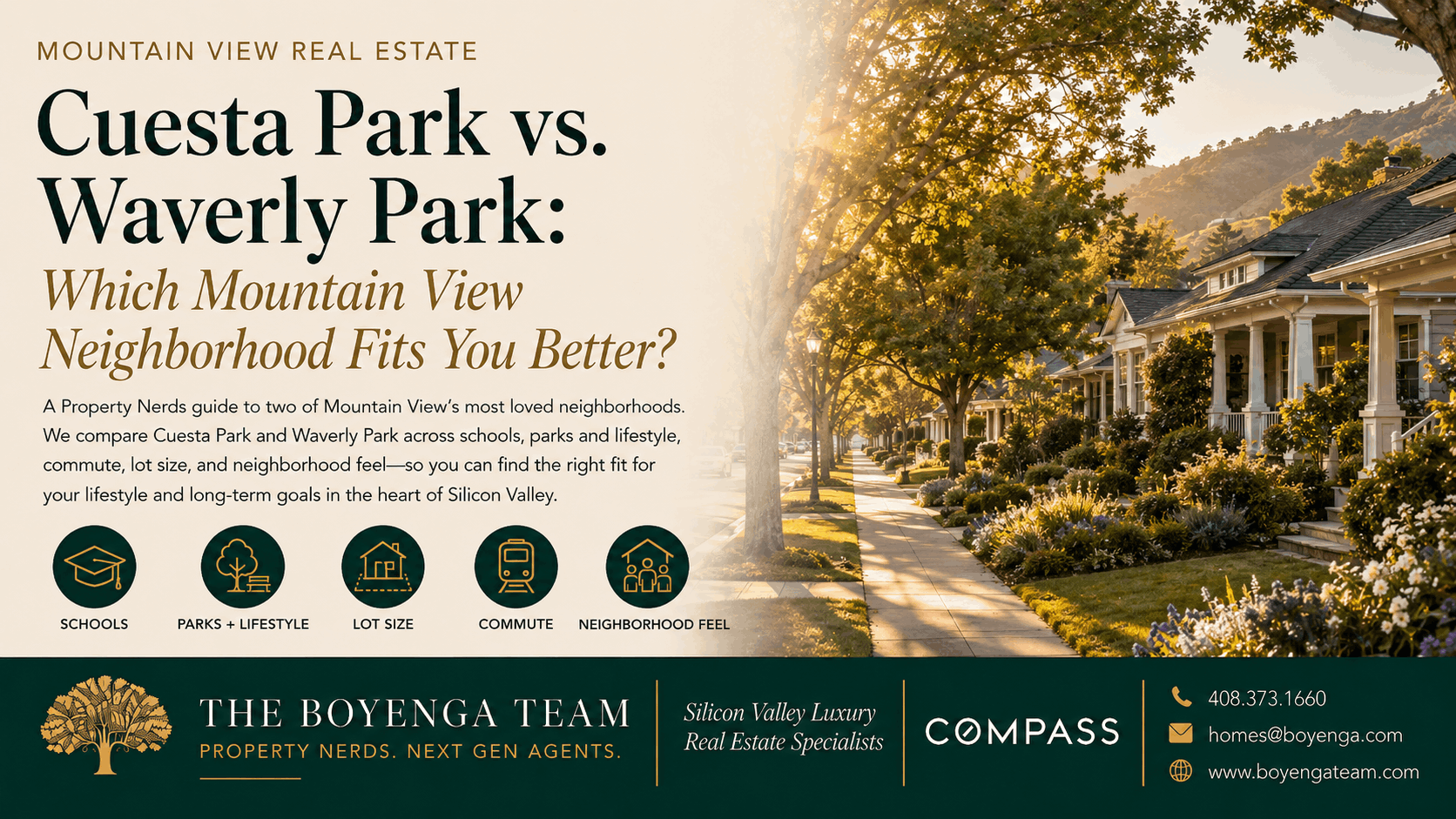
In Mountain View real estate, Cuesta Park and Waverly Park are two of the city’s most desirable family-oriented neighborhoods — but they do not solve the same buyer problem.
Both offer established residential streets, strong Silicon Valley access, proximity to Los Altos, and appeal for buyers who want more of a single-family neighborhood feel than downtown condos, Whisman Station townhomes, or transit-oriented communities. But the lifestyle rhythm is different.
Cuesta Park is often about park-centered family living, convenience, and a slightly more connected daily routine.
Waverly Park is often about quiet streets, larger-lot energy, privacy, and a more premium residential feel.
That is the Property Nerd truth: the best neighborhood is not always the “more expensive” one or the “better-known” one. The best neighborhood is the one where the lot, commute, schools, floor plan, lifestyle, and long-term resale story line up.
At the Boyenga Team, we help buyers compare Mountain View neighborhoods at the micro-market level. We do not just ask, “Which area do you like?” We ask how you live: where you work, where your kids may go to school, how much yard you need, whether you want walkability, whether you care about future expansion, and how the home will perform when it is time to sell.
This guide breaks down Cuesta Park vs. Waverly Park for buyers and sellers who want to understand Mountain View family neighborhoods more deeply.
The Big Picture: Two Strong Mountain View Family Neighborhoods
Cuesta Park and Waverly Park both sit in the southern portion of Mountain View, close to Los Altos and well positioned for Silicon Valley commuters. Both are attractive to buyers who want a more residential, established neighborhood environment.
But the emotional pull is different.
Cuesta Park often feels more park-driven and conveniently connected. It is anchored by Cuesta Park itself, a major city park at 615 Cuesta Drive with amenities including BBQ facilities, bocce ball, fitness equipment, picnic tables, playground, restrooms, tennis courts, volleyball courts, walking paths, and an off-leash dog area.
Waverly Park often feels more tucked away, quiet, and residential. Buyers frequently associate it with larger homes, larger lots, mature landscaping, and a more premium single-family feel.
For many buyers, the decision comes down to this:
Cuesta Park is ideal if you want family convenience, park access, and a central neighborhood feel close to Los Altos and downtown Mountain View.
Waverly Park is ideal if you want more residential calm, lot presence, privacy, and a neighborhood that feels slightly more estate-like by Mountain View standards.
Cuesta Park: The Park-Centered Family Lifestyle
Cuesta Park is one of Mountain View’s most beloved family neighborhoods because it feels practical, comfortable, and easy to live in.
The neighborhood’s identity is shaped by the park. For families, that matters. A major neighborhood park changes daily life. It gives kids space to play, dogs a place to run, adults walking paths, and families a natural community gathering point.
Buyers who love Cuesta Park often imagine:
Walking to the park after school
Weekend tennis or playground time
Dog walks
Picnics
Birthday parties
Easy access to Los Altos
A short drive to Castro Street
A neighborhood with a true family rhythm
The housing stock often includes ranch-style homes, remodeled family homes, expanded homes, and newer custom properties. Some homes are charming and livable. Others are clear remodel or expansion candidates. The neighborhood attracts a wide buyer pool because it checks many boxes without feeling overly formal.
Waverly Park: Quiet Streets, Larger-Lot Energy, and Residential Calm
Waverly Park is one of Mountain View’s strongest move-up neighborhoods for buyers who want a quieter, more spacious, more residential experience.
Where Cuesta Park has a strong park-centered identity, Waverly Park often sells on street feel, lot utility, privacy, and a sense of neighborhood stability. Buyers may be drawn to larger yards, expanded homes, and a more classic family-home environment.
Waverly Park can feel more removed from downtown energy while still being very connected to Mountain View, Los Altos, Sunnyvale, Palo Alto, and Cupertino.
Buyers who love Waverly Park often imagine:
A larger backyard
A quieter block
Room for kids, guests, or future expansion
More privacy
A home office with separation
A pool or outdoor entertaining space
A long-term family home
A neighborhood that feels established and peaceful
The housing stock can include ranch homes, remodeled properties, expanded family homes, and newer construction. For buyers seeking a more premium single-family experience in Mountain View, Waverly Park often rises to the top of the list.
Schools: Verify the Exact Address
For family buyers, schools are often a major part of the Cuesta Park vs. Waverly Park decision. But school assignments are address-specific and should always be verified directly with the appropriate district before writing an offer.
Mountain View Whisman School District serves transitional kindergarten through eighth grade in Mountain View. The district notes that its current school boundaries went into effect in the 2019–20 school year and provides interactive and printable boundary maps for families to locate assigned schools.
For high school, many Mountain View addresses feed into Mountain View Los Altos High School District. MVLA describes its district as offering a strong academic program, and its district site notes that both Mountain View High and Los Altos High have been ranked in the top 2% nationally by U.S. News & World Report.
The Property Nerd rule is simple: never assume school assignment based only on neighborhood name, listing portal, or hearsay. Always verify by exact address.
That matters because a buyer may prefer one property over another based on a school pathway, walking route, commute logistics, or long-term resale expectations.
Lifestyle Comparison: Park Access vs. Residential Quiet
Cuesta Park and Waverly Park both appeal to families, but the lifestyle emphasis is different.
Cuesta Park has a stronger “daily activity” feel. The park gives the neighborhood a built-in lifestyle anchor. Buyers who want accessible recreation, easy outings, and a more visible family community may prefer Cuesta Park.
Waverly Park has a stronger “private residential retreat” feel. The appeal is often less about one central amenity and more about the total neighborhood atmosphere: quiet streets, lot size, mature landscaping, and homes that support long-term family living.
The Property Nerd version:
Cuesta Park feels like a neighborhood built around family convenience.
Waverly Park feels like a neighborhood built around residential breathing room.
Both are strong. They simply deliver different kinds of comfort.
Commute: Similar Geography, Different Daily Flow
Both neighborhoods are well positioned for Silicon Valley commuters. Buyers may be commuting to Google, LinkedIn, Intuit, Apple, Nvidia, Stanford, Palo Alto, Sunnyvale, Cupertino, Los Altos, or other Peninsula/South Bay destinations.
But commute geometry is not just about distance.
It depends on:
Which side of the neighborhood the home sits on
Access to El Camino Real
Access to Highway 85
Access to Highway 237 or 101
Cut-through routes
School drop-off patterns
Traffic lights
Bike routes
Whether the buyer needs downtown Mountain View, Los Altos, or Caltrain
Whether the commute is toward Palo Alto, Sunnyvale, Cupertino, or North Bayshore
Cuesta Park may feel more central for buyers who want to move between downtown Mountain View, Los Altos, and major daily amenities.
Waverly Park may feel better for buyers who prioritize a quieter departure pattern and access toward major commute routes while staying in a calmer residential setting.
The best test is not a map search. The best test is driving the actual route during your real commute window.
Lot Size and Yard Utility
This is where Waverly Park often has an emotional advantage for buyers who want more space.
Many Waverly Park buyers are looking for yards that can support a bigger family lifestyle: entertaining, play space, gardens, pool potential, outdoor kitchens, or future expansion. The neighborhood’s residential feel often supports this buyer psychology.
Cuesta Park can also offer desirable lots and strong family yards, but the buyer’s premium may be more connected to park access, location convenience, and overall neighborhood warmth.
The Property Nerd question is not simply, “Which lot is bigger?”
The better question is:
Is the lot usable?
Is it private?
Does it get good sunlight?
Is the backyard functional?
Is there room to expand?
Are there tree constraints?
Does the home sit well on the lot?
Is the yard visible from the main living spaces?
Does the lot support the life the buyer wants?
A smaller Cuesta Park lot with better layout and park access may beat a larger but awkward Waverly Park lot for one buyer. A larger Waverly Park lot with privacy and expansion potential may easily beat a more compact Cuesta Park property for another.
Architecture and Housing Stock
Both neighborhoods include a mix of older ranch-style homes, updated family homes, expanded properties, and newer custom builds. The architecture is less specialized than Monta Loma, which is known for Eichler and mid-century modern identity, but both Cuesta Park and Waverly Park have strong remodel and redevelopment appeal.
Cuesta Park homes often appeal to buyers who want comfort, convenience, and the ability to live well now while improving over time.
Waverly Park homes often appeal to buyers who want more scale, a larger family footprint, or the ability to create a more substantial long-term home.
For sellers, this changes the marketing.
A Cuesta Park home should often be positioned around lifestyle, park access, natural light, family flow, and daily convenience.
A Waverly Park home should often be positioned around lot value, privacy, quiet streets, floor plan, expansion potential, and premium residential feel.
Buyer Psychology: Who Chooses Cuesta Park?
Cuesta Park buyers often include:
Families who want park access
Move-up buyers from townhomes or condos
Buyers comparing Mountain View and Los Altos
Tech professionals who want practical commute access
Buyers who value convenience and community
Buyers who want a neighborhood with a true family rhythm
Relocation buyers who need an easy-to-understand lifestyle story
These buyers may be drawn to the fact that the neighborhood feels active, useful, and connected. They are not only buying the house. They are buying the everyday routine around the house.
Buyer Psychology: Who Chooses Waverly Park?
Waverly Park buyers often include:
Move-up families
Buyers wanting larger lots
Tech executives and professionals
Buyers seeking more privacy
Families comparing Mountain View, Los Altos, Sunnyvale, and Palo Alto
Buyers who want long-term residential stability
Remodel or expansion-minded buyers
Buyers who want a quieter neighborhood identity
These buyers may be more focused on space, lot presence, privacy, and a home they can grow into.
Waverly Park often speaks to buyers who want Mountain View convenience but with more residential depth.
Pricing Logic: Why the Two Neighborhoods Trade Differently
Pricing in Cuesta Park and Waverly Park is shaped by different buyer motivations.
In Cuesta Park, buyers may pay a premium for:
Proximity to Cuesta Park
Neighborhood convenience
Family lifestyle
Access to Los Altos and downtown Mountain View
Good school pathways
Updated homes with practical layouts
Usable yards
Move-in-ready condition
In Waverly Park, buyers may pay a premium for:
Larger lots
Quiet streets
Privacy
Home scale
Remodel or expansion potential
Residential prestige
Family functionality
Long-term resale appeal
The mistake is comparing them too mechanically.
Price per square foot does not tell the whole story. A Cuesta Park home may sell strongly because of emotional park lifestyle and convenience. A Waverly Park home may sell strongly because of lot utility and quiet-street demand.
The Boyenga Team looks at the value stack: neighborhood, street, lot, home, school path, commute, condition, and buyer pool.
Which Neighborhood Is Better for Families?
Both can be excellent for families.
Choose Cuesta Park if your family prioritizes:
Park access
Convenience
A more connected daily routine
Easy outings
A neighborhood activity anchor
Access to Los Altos and downtown Mountain View
A practical family lifestyle
Choose Waverly Park if your family prioritizes:
Quiet streets
Larger yards
Privacy
More residential space
Long-term expansion potential
A premium single-family feel
A calmer neighborhood rhythm
The best choice depends on how your family actually lives.
If your family wants to walk to the park several times a week, Cuesta Park may feel hard to beat.
If your family wants a larger backyard and quieter residential setting, Waverly Park may feel more aligned.
What Sellers Should Know in Cuesta Park
If you are selling in Cuesta Park, the marketing should not simply say “great Mountain View location.”
It should tell the park-centered lifestyle story.
The Boyenga Team would emphasize:
Proximity to Cuesta Park
Family-friendly daily rhythm
Outdoor recreation
Functional floor plan
Natural light
Yard usability
Access to Los Altos
Access to downtown Mountain View
Commute convenience
School-path verification resources
Strong buyer demand for established neighborhoods
Cuesta Park sellers should make the home feel bright, livable, and connected to the neighborhood’s lifestyle advantage.
What Sellers Should Know in Waverly Park
If you are selling in Waverly Park, the marketing should lead with residential quality.
The Boyenga Team would emphasize:
Quiet street appeal
Lot size and usability
Privacy
Outdoor living
Expansion potential
Family functionality
Home scale
Neighborhood stability
Access to Mountain View, Los Altos, Sunnyvale, and Cupertino
Long-term resale confidence
Waverly Park sellers should make the lot and floor plan easy to understand. Buyers need to feel the space, privacy, and future optionality.
The Boyenga Team’s Property Nerd Approach
The Boyenga Team helps Mountain View buyers and sellers decode neighborhoods at a deeper level.
For buyers, we look at:
School pathway verification
Commute geometry
Street quality
Lot utility
Natural light
Home condition
Floor plan function
Outdoor space
Remodel potential
Neighborhood resale strength
Micro-location pricing
For sellers, we identify:
The likely buyer pool
The strongest lifestyle story
The right prep strategy
The right pricing strategy
The best visual presentation
How to position the home against nearby competition
How to create buyer urgency without generic marketing
Cuesta Park and Waverly Park are both strong neighborhoods, but they require different strategies. That is where local expertise matters.
Final Property Nerd Takeaway
Cuesta Park and Waverly Park are two of Mountain View’s best family neighborhoods, but they fit different lifestyles.
Cuesta Park is best for buyers who want park access, convenience, family activity, and a connected daily rhythm.
Waverly Park is best for buyers who want quiet streets, larger-lot energy, privacy, and a more premium residential feel.
The right choice is not about which neighborhood is universally better.
It is about which one fits your family, commute, budget, school needs, yard goals, and long-term resale strategy.
At the Boyenga Team, we help buyers and sellers understand the details behind Mountain View neighborhood value — because in Silicon Valley real estate, the micro-location is often the market.
The Boyenga Team
Mountain View & Silicon Valley Real Estate Experts
Compass
Website: www.BoyengaTeam.com
Email: homes@boyenga.com