

Blog > Campbell vs. Cambrian: Walkability, Schools, Commutes, and Home Values
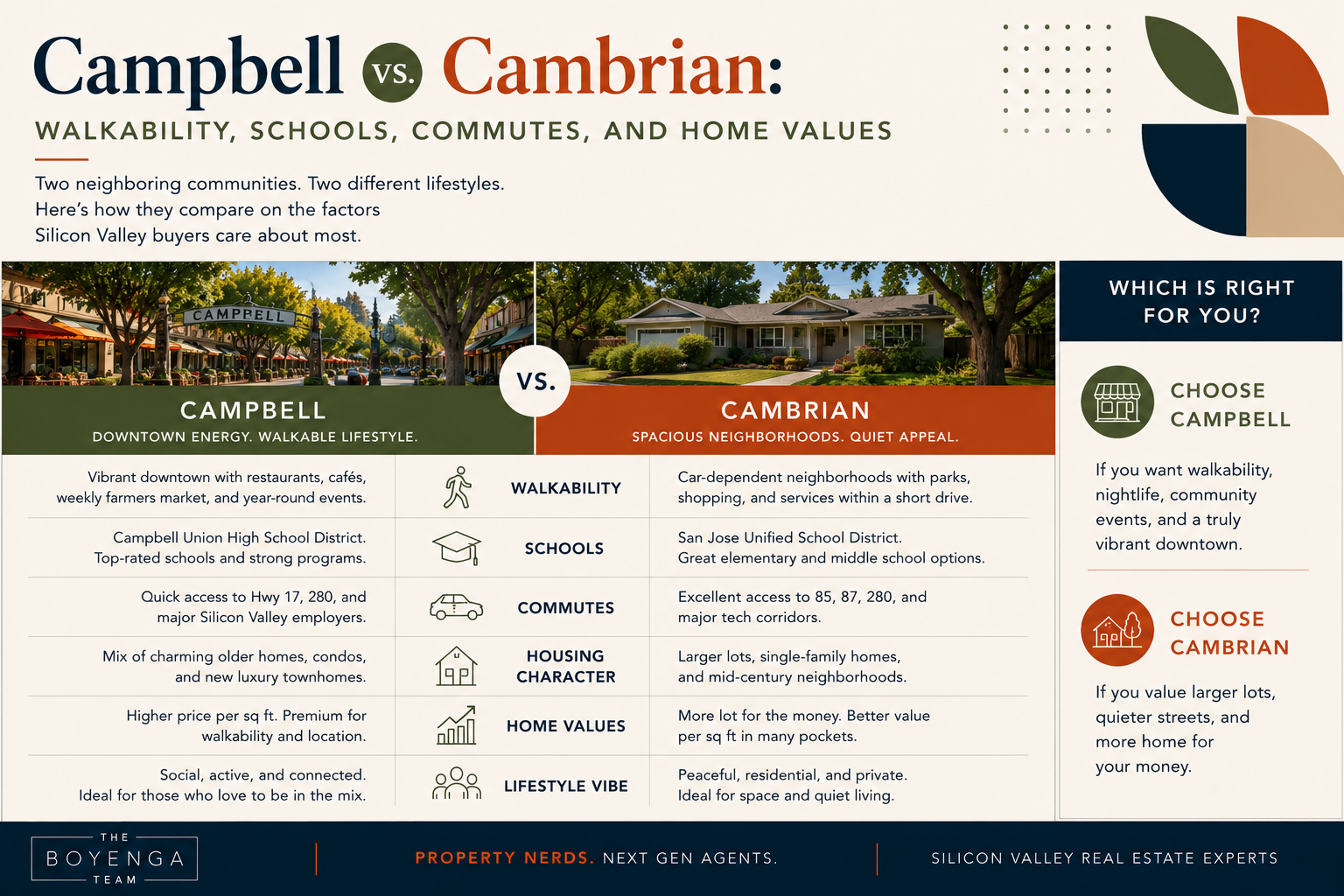 Campbell and Cambrian sit only a few miles apart, yet they represent two distinctly different interpretations of Silicon Valley living.
Both offer excellent access to major employers, highly regarded neighborhoods, and strong long-term housing demand. Both attract buyers seeking established communities rather than master-planned developments. Yet despite their proximity, buyers searching in Campbell often prioritize a very different lifestyle than those who ultimately purchase in Cambrian.
The difference isn't simply about price.
It's about how each community solves everyday life.
Campbell appeals to buyers who want walkability, an active downtown, and a neighborhood where restaurants, coffee shops, farmers markets, and local events become part of a weekly routine. Cambrian attracts buyers looking for quieter residential streets, larger lots, neighborhood schools, and a greater emphasis on space and neighborhood stability.
Understanding those trade-offs helps explain why these neighboring markets continue attracting different buyer profiles despite sharing much of the same geography.
The Boyenga Team regularly analyzes Silicon Valley neighborhoods through this broader ownership lens at https://boyengarealestateteam.com, helping buyers compare communities based on long-term lifestyle rather than simply price per square foot.
Campbell Was Built Around Its Downtown
Campbell's identity begins with its downtown.
East Campbell Avenue has evolved into one of the South Bay's most successful pedestrian-oriented districts, filled with independent restaurants, cafés, wine bars, boutiques, and one of Silicon Valley's most popular weekly farmers markets. Community events, seasonal festivals, and outdoor dining create an atmosphere that feels remarkably active throughout the year.
For many residents, owning a home in Campbell means walking to dinner, meeting friends without driving, or spending Saturday mornings exploring downtown.
That walkability influences more than lifestyle.
It also shapes buyer demand.
Neighborhoods within comfortable walking distance of downtown consistently attract buyers willing to pay premiums for convenience and community energy.
Cambrian Prioritizes Neighborhood Over Downtown
Cambrian tells a different story.
Rather than centering around a single commercial district, its appeal comes from the neighborhoods themselves.
Wide residential streets, mature landscaping, neighborhood parks, and an abundance of single-family homes create an environment where daily life happens closer to home. Shopping centers and restaurants remain easily accessible, but they rarely define the ownership experience in the same way they do in Campbell.
Instead, buyers are often drawn by consistency.
The neighborhoods feel established.
The streets feel quieter.
The pace feels slower.
For buyers planning to remain in one home for many years, that sense of stability becomes a significant part of Cambrian's appeal.
Housing Stock Reflects Different Priorities
Architecture reinforces those differences.
Campbell offers a diverse collection of homes that reflects its evolution over time. Bungalows, Craftsman residences, traditional ranch homes, condominiums, and newer townhome developments often exist within close proximity of one another. Redevelopment has introduced additional housing choices while preserving much of the city's original character.
Cambrian feels more residential from the outset.
Much of its housing consists of well-maintained ranch homes on comfortably sized lots, many built during Silicon Valley's post-war growth. Buyers frequently discover opportunities for remodeling, expansion, or long-term customization while maintaining generous outdoor space.
Neither community is defined by luxury estates.
Instead, both succeed by offering neighborhoods that remain practical, livable, and consistently in demand.
Schools Shape Demand Differently
Education remains one of the strongest drivers of buyer interest throughout both communities, although the underlying dynamics differ.
Campbell buyers often evaluate a combination of Campbell Union School District, Campbell Union High School District, and nearby private school options. School assignment supports demand, but it frequently competes alongside downtown accessibility and overall lifestyle.
Cambrian buyers, by contrast, often begin their search with schools.
Attendance boundaries associated with Cambrian School District, Union School District, and portions of neighboring districts significantly influence buyer activity. Buyers frequently narrow their searches around specific elementary school assignments long before selecting an individual home.
As a result, school boundaries tend to create smaller micro-markets throughout Cambrian than many buyers initially expect.
Commute Convenience Is Strong in Both Markets
Few buyers choose between Campbell and Cambrian based solely on commute.
Both offer outstanding regional connectivity.
Highway 17, Highway 85, Highway 87, Interstate 280, and nearby expressways provide convenient access to employment centers throughout San Jose, Cupertino, Santa Clara, Sunnyvale, and beyond.
Where the experience differs is after the workday ends.
Campbell encourages residents to remain connected to its downtown.
Cambrian encourages residents to retreat into quieter neighborhoods.
Both approaches appeal to different personalities.
Home Values Follow Different Patterns
Although both communities have demonstrated impressive long-term appreciation, the reasons behind buyer demand differ.
Campbell's pricing reflects the value buyers place on walkability, mixed-use development, downtown amenities, and limited inventory near the city's commercial core. Buyers often pay a premium for location even when lot sizes remain relatively modest.
Cambrian's value proposition centers on land.
Larger lots and opportunities for future expansion create enduring demand among buyers planning for long-term ownership.
Neither market consistently outperforms the other.
They simply derive their value from different characteristics.
Which Buyer Thrives in Each Community?
The distinction between Campbell and Cambrian becomes clearest when considering the people who choose them.
Campbell often attracts buyers who want an active neighborhood lifestyle without sacrificing suburban comfort. They appreciate walking to restaurants, participating in community events, and living where entertainment becomes part of everyday life.
Cambrian appeals to buyers seeking more traditional suburban living. They value larger yards and neighborhoods where daily routines revolve more around home than downtown.
Neither choice represents a compromise.
Each reflects a different vision of what makes a neighborhood enjoyable over the long term.
The Boyenga Team regularly explores these relationships between neighborhood identity, buyer psychology, and market performance through the Property Nerds Blog, helping buyers understand why communities that appear similar on a map often behave very differently in practice.
Read more at https://www.boyengateam.com/blog.
Buyers interested in distinctive architectural neighborhoods throughout Silicon Valley—including Eichler communities and other notable mid-century modern areas—can also explore https://bayareaeichlerhomes.com and https://midmodhomes.com.
The Property Nerd Take
Campbell and Cambrian are separated by only a few miles, but they solve different lifestyle equations. Campbell offers a walkable, socially connected environment anchored by one of Silicon Valley's most successful downtowns. Cambrian emphasizes neighborhood stability, larger lots, neighborhood schools, and the quiet confidence of established residential communities.
The strongest purchase isn't determined by which market is appreciating faster or which neighborhood commands the higher price. It's determined by choosing the community whose daily rhythm matches the life you want to live. When that alignment exists, long-term ownership becomes about much more than real estate—it becomes about belonging.
keep exploring · property nerd guides
San Jose homes, neighborhoods & schools in one guide
Live listings, recent sales, ZIP codes, school districts and commute notes for San Jose, from the Property Nerds® of the Boyenga Team at Compass.
Open the San Jose guideWhat’s my home worth?
Talk to a Property Nerd: (408) 373-1660 · (650) 383-8606 · How we sell homes
city guides Palo Alto · Los Altos · Menlo Park · Cupertino · Sunnyvale · Los Gatos