

Blog > Birdland and Raynor Park: Classic Sunnyvale Neighborhoods with Big Buyer Demand
Birdland and Raynor Park: Classic Sunnyvale Neighborhoods with Big Buyer Demand
by
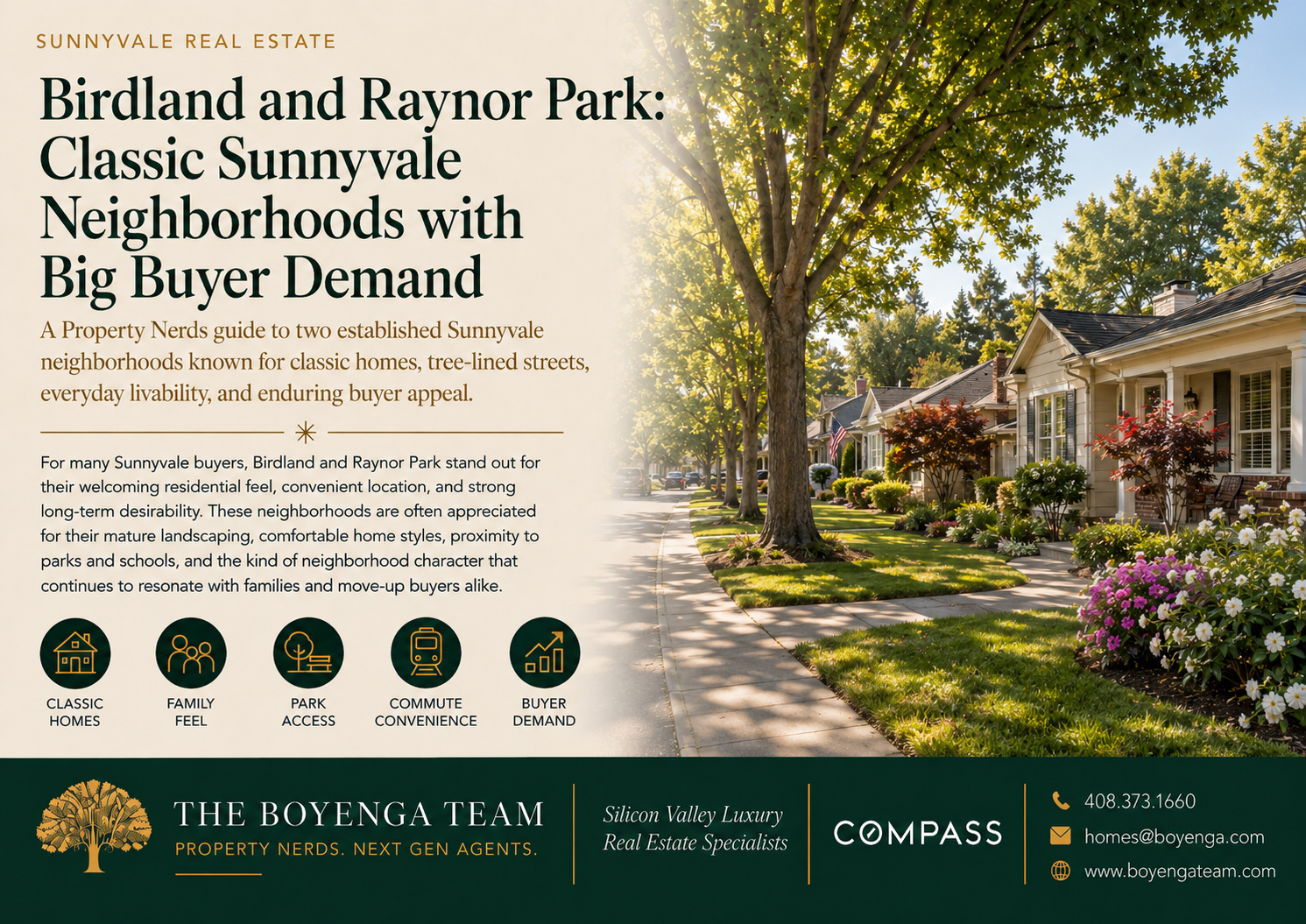
Birdland and Raynor Park are the kind of Sunnyvale neighborhoods that make Property Nerds lean forward.
Not because they are flashy.
Because they make sense.
They sit in one of Sunnyvale’s most buyer-sensitive zones, where families, tech professionals, remodel buyers, Apple-area commuters, school-focused buyers, and long-term Silicon Valley homeowners all tend to understand the value quickly. The streets feel residential. The homes often have usable lots. Raynor Park gives the area a major neighborhood anchor. The commute geometry works for multiple Silicon Valley job centers. And the housing stock has exactly the kind of “now or next chapter” flexibility buyers love: move in, refresh, remodel, expand, or rebuild over time.
That is why Birdland Sunnyvale, Raynor Park Sunnyvale, and surrounding Sunnyvale family neighborhoods continue to generate serious buyer demand.
At the Boyenga Team, we see Birdland and Raynor Park as classic Silicon Valley value-stack neighborhoods. Buyers are not paying for one thing. They are paying for the combination: location, land, schools, commute, park access, neighborhood feel, single-family scarcity, and long-term resale logic.
The Property Nerd Thesis: Birdland and Raynor Park Are “Fundamentals” Neighborhoods
Some neighborhoods sell on lifestyle glamour. Others sell on walkability, downtown energy, or luxury prestige. Birdland and Raynor Park sell on fundamentals.
That means the value comes from the pieces serious buyers care about when they are thinking long-term: Is the street quiet? Is the lot usable? Can the house be improved? Does the commute work? Are parks nearby? Are school pathways worth verifying? Will future buyers understand the location? Does the home have flexibility?
Birdland is commonly described as surrounding Raynor Park, with bird-themed street names such as Quail, Peacock, Nightingale, and Parrot helping give the neighborhood its name and identity. Local neighborhood descriptions also note that the area began largely with single-story homes and has seen larger remodeled or rebuilt homes appear over time.
That evolution is important. Birdland and Raynor Park are not frozen-in-time ranch neighborhoods. They are established Sunnyvale neighborhoods where older homes, remodels, expansions, and newer construction can sit near each other. For buyers, that creates opportunity. For sellers, it creates a need for precise positioning.
Raynor Park Is the Lifestyle Anchor
Raynor Park is one of the reasons this area has such strong family-buyer appeal.
The City of Sunnyvale lists Raynor Park at 1565 Quail Avenue and describes it as an 11.9-acre park with dinosaur-themed play areas, picnic sites, a playground, horseshoe pits, basketball courts, a reservable multi-use sports field, and two ballfields. The city also lists amenities such as BBQ sites, electricity at select picnic sites, parking, restrooms, tables, and reservable spaces.
That matters because parks change daily life.
A home near Raynor Park is not just near green space. It is near a routine. Families picture weekend playdates, birthday parties, sports practice, walks, casual meetups, and easy outdoor time without needing to drive across town. Buyers with children, dogs, visiting grandparents, or active lifestyles can immediately understand the benefit.
This is what the Boyenga Team calls a “lifestyle utility premium.” It is not abstract. It shows up in how buyers feel when they tour the neighborhood.
Why Birdland Gets So Much Buyer Attention
Birdland has a very specific buyer magnetism because it combines residential calm with Silicon Valley access.
The neighborhood has the kind of established single-family character many buyers want in Sunnyvale: ranch homes, expanded homes, larger remodeled properties, mature streets, and a sense that the area has been loved over time. Many buyers are not looking for a brand-new subdivision. They want a neighborhood that feels settled.
Birdland also sits in a powerful part of the Silicon Valley commute map. Local neighborhood guides often emphasize Birdland’s proximity to Apple-area employment and major routes such as Highway 85 and Interstate 280, with nearby access to shopping and services along Homestead and surrounding corridors.
The buyer psychology is simple: Birdland feels like a place where you can live a family life and still stay close to the Silicon Valley machine.
That is a valuable combination.
Big Buyer Demand Comes From Multiple Buyer Pools
The strongest Sunnyvale neighborhoods do not rely on one buyer type. Birdland and Raynor Park attract several.
Family buyers often respond to the park access, established streets, school-path considerations, yards, and the feeling of a true residential neighborhood.
Tech buyers often respond to the commute geometry. Sunnyvale’s official employer data lists Google, Apple, Amazon, Intuitive Surgical, Lockheed Martin, Meta, Synopsys, Applied Materials, Fortinet, Cepheid, Proofpoint, LinkedIn, and others among the city’s largest employers, which helps explain why Sunnyvale buyers pay close attention to tech proximity and commute flexibility.
Move-up buyers often respond to the single-family inventory. They may be coming from a condo, townhome, or smaller home and looking for a yard, garage, office, and long-term growth potential.
Remodel buyers see opportunity in older homes that can be opened up, expanded, modernized, or reimagined.
Builder and end-user redevelopment buyers may see land value, especially where lot size, street quality, and surrounding remodels support a higher future ceiling.
That buyer-pool overlap is why a well-positioned Birdland or Raynor Park listing can create strong attention. The home may speak to families, tech professionals, remodelers, and long-term owners at the same time.
The Housing Stock: Ranch Homes, Remodels, and Rebuild Potential
A major part of Birdland and Raynor Park’s appeal is the housing stock.
Many homes in this broader pocket have classic Sunnyvale bones: single-level or originally single-level ranch layouts, usable yards, attached garages, and floor plans that can often be improved. Some homes have been expanded. Some have been rebuilt. Some are still original or lightly updated. That variety is exactly what makes the market interesting.
A dated ranch here is not automatically a weak property. It may be a strong opportunity if the lot, street, school path, commute, and park access are right.
The key is understanding what the home really is.
Is it a move-in-ready family home?
Is it a cosmetic refresh?
Is it a major remodel candidate?
Is it an expansion opportunity?
Is it a builder property?
Is it land value with a livable structure?
The Boyenga Team’s Property Nerd approach starts with that diagnosis. The right marketing strategy depends on whether buyers should be paying for current condition, future potential, or both.
The School Conversation: Important, But Address-Specific
School-focused buyers often look closely at this part of Sunnyvale, but school assumptions can be risky.
Sunnyvale is served by multiple school districts depending on the exact address. Sunnyvale School District provides a School Finder for address-based school lookup, Cupertino Union School District states that its school locator gives preliminary assignments based on CUSD boundaries, and Fremont Union High School District states that its boundary map specifies attendance areas and advises families making major home-buying or rental decisions to check official locator tools.
The Santa Clara County Office of Education also provides a district locator to determine which school district serves a particular street address or parcel, while advising families to contact the district for school assignment details.
That means the Property Nerd rule is non-negotiable: verify the exact address before writing an offer.
A neighborhood name, listing portal, or casual school shorthand is not enough. One block can change the buyer conversation. For sellers, school appeal should be marketed carefully and accurately, with buyers directed to confirm directly with the applicable district.
Why Park Access and School Demand Work Together
Raynor Park is powerful because it supports the same buyer psychology as school-driven demand.
Families want stability. They want routines. They want places where kids can play, neighbors can gather, and daily life feels manageable. A home near a major neighborhood park can feel more valuable because it expands the lifestyle beyond the property line.
This is especially important in Silicon Valley, where many buyers are choosing between larger homes farther away, smaller homes closer to work, and expensive single-family homes in school-sensitive pockets. Birdland and Raynor Park can feel like the middle path: residential, useful, commute-aware, and family-friendly.
That is the value.
The buyer is not just asking, “How big is the house?”
They are asking, “Can we build a life here?”
Commute Geometry: The Hidden Demand Driver
Birdland and Raynor Park benefit from being in a highly strategic Sunnyvale location.
Buyers may be commuting toward Apple in Cupertino or Sunnyvale, Google in Mountain View or Sunnyvale, LinkedIn, Amazon, Santa Clara, Palo Alto, San Jose, or hybrid roles that change over time. That makes commute flexibility a major value driver.
The Property Nerd phrase is “commute optionality.”
A household may have one person going toward Cupertino and another toward Mountain View. A buyer may work from home three days a week but still need easy access to a campus twice a week. Another may be relocating from outside the Bay Area and trying to land somewhere central enough to survive future job changes.
Birdland and Raynor Park work because they are not overly dependent on one employer. They sit within the broader Silicon Valley job web.
For sellers, that commute story should be part of the marketing. Not just “great location,” but “strong access to Apple, Google, Sunnyvale employers, Cupertino, Mountain View, Santa Clara, and major commute corridors.”
Current Market Context: This Is a High-Value Sunnyvale Pocket
Neighborhood-level market data can be noisy because the sample sizes are small, but it still gives useful context.
Realtor.com’s 2026 Birdland market snapshot showed a median listing price around $2.49 million and median days on market around 27 days; the same page listed nearby Raynor at roughly $2.495 million median listing price in its neighborhood comparison. Realtor.com also showed the 94087 ZIP code with a median listing price around $2.59 million in the same Birdland page’s zip-code comparison.
That does not mean every Birdland or Raynor Park home is worth that number. A specific home’s value depends on condition, lot size, street, school path, remodel quality, disclosures, and current buyer demand. But the snapshot helps explain why sellers and buyers treat this pocket seriously: it trades in a meaningful Sunnyvale value tier.
The Boyenga Team uses this type of market data as a starting point, not a pricing answer. The real pricing work happens at the property level.
Birdland vs. Raynor Park: Are They Different?
Birdland and Raynor Park often overlap in buyer conversation, but they are not always used the same way.
Birdland is typically the broader neighborhood identity, strengthened by the bird-named streets and the residential pattern around Raynor Park. Raynor Park can refer to the actual city park, the homes closest to the park, or nearby real estate micro-pockets that benefit from the park’s lifestyle pull.
For buyers, the distinction is less about the label and more about the lived experience.
Is the home close enough to Raynor Park for the park to be part of daily life?
Is the street quiet?
Does the home sit on a usable lot?
Is it in the desired school boundary after official verification?
Does the commute work?
Is the property priced for condition?
For sellers, the label should be used strategically but accurately. If the home is in a Birdland pocket near Raynor Park, the marketing should explain both the neighborhood identity and the park lifestyle.
What Buyers Notice First
Buyers in Birdland and Raynor Park often notice the street before they notice the kitchen.
They pay attention to whether the block feels quiet, whether homes are well maintained, whether there is cut-through traffic, whether the sidewalks and yards feel family-friendly, and whether the neighborhood has a settled residential rhythm.
Then they notice the lot.
Is the backyard usable? Is there room for outdoor dining, play, gardening, an office studio, future expansion, or an ADU? Does the home sit well on the lot? Is the yard private? Does it get sunlight? Is landscaping helping or hiding the property?
Then they notice the home itself.
Is the floor plan functional? Can the kitchen connect to family life? Is there a real work-from-home space? Are the bedrooms grouped well? Is the garage usable? Are the systems older? Are inspections available? Is the home move-in ready, or is it priced as an opportunity?
This is why seller presentation matters so much.
Why Dated Homes Can Still Create Big Demand
In Birdland and Raynor Park, dated does not automatically mean undesirable.
A dated home may have exactly what the buyer wants: a good lot, a quiet street, a strong commute, park access, and future optionality. Many Silicon Valley buyers are comfortable improving a home if the location is right.
The problem is not dated. The problem is unclear.
If a dated home is dark, cluttered, poorly photographed, and missing inspections, buyers may get nervous. If that same home is clean, bright, staged, landscaped, inspected, and marketed as a clear opportunity, buyers may compete.
The Boyenga Team’s seller-prep philosophy is to make the value obvious without over-remodeling. Paint, floors, lighting, windows, landscaping, staging, cleaning, and inspections often matter more than a full pre-sale kitchen remodel.
The goal is not to make the home look like new construction.
The goal is to help buyers understand the opportunity.
Seller Prep: What Matters Most in Birdland and Raynor Park
Sellers in Birdland and Raynor Park should focus on three big themes: light, land, and lifestyle.
Light means opening up the home visually. Clean windows, remove heavy drapes, improve lighting, repaint dark rooms, and stage in a way that makes the floor plan feel easy.
Land means revealing the lot. Trim landscaping, clean patios, show the backyard as usable space, and make buyers understand the future potential.
Lifestyle means showing how the home works for modern Silicon Valley living. Stage an office. Make the kitchen and dining flow easy to understand. Show outdoor seating. Clean the garage. Highlight EV charging or electrical readiness if present. Make the home feel like it can support a family, a hybrid worker, and a long-term owner.
Major remodels should be considered carefully. Realtor.com’s Birdland seller FAQ notes that minor cosmetic updates such as paint, fixtures, and landscaping can help, while major renovations may not return full cost and can depend heavily on the situation.
That aligns with the Boyenga Team’s Property Nerd approach: improve what changes buyer behavior, avoid spending where the buyer may not reward you.
The Remodeling Penalty: A Real Risk in This Neighborhood
Because Birdland and Raynor Park homes can attract remodel buyers and builders, sellers should be careful about over-upgrading before sale.
A seller may think a new kitchen is necessary. But if the likely buyer plans to open walls, expand, or rebuild, that kitchen may not return its cost. A seller may install trendy flooring, but a buyer may prefer hardwood, warm modern finishes, or a full redesign. A seller may remodel bathrooms, but the buyer may be more focused on the lot and floor plan.
That is the remodeling penalty.
It happens when seller money goes into improvements the buyer does not value enough to pay for.
The better question is: will this upgrade increase the buyer pool, reduce objections, or strengthen offers?
If yes, do it.
If no, leave the choice to the buyer.
What Buyers Should Watch For
Buyers should love the fundamentals, but still do real due diligence.
In older Birdland and Raynor Park homes, buyers should study roof condition, sewer laterals, foundation, drainage, electrical systems, plumbing, HVAC, windows, prior additions, permits, and pest findings. For remodel or expansion ideas, buyers should consult the City of Sunnyvale, contractors, architects, engineers, and qualified professionals.
They should also walk the neighborhood at different times of day. A home can feel different on a quiet Sunday morning than during weekday commute or school pickup times. Buyers should test the commute, study traffic exposure, check noise, verify schools, and think about future resale.
The right Birdland or Raynor Park purchase can be excellent. But it should be purchased with eyes open, not just emotion.
How the Boyenga Team Positions Birdland and Raynor Park Homes
The Boyenga Team positions these homes around the complete value stack.
For family buyers, we highlight neighborhood feel, park access, school-verification resources, yard usability, bedroom layout, storage, and daily livability.
For tech buyers, we highlight commute geometry, home office function, garage utility, EV readiness where applicable, and access to major Sunnyvale, Cupertino, Mountain View, and Santa Clara employers.
For remodel buyers, we highlight lot value, single-level potential, expansion possibilities, and the opportunity to customize.
For builder and land-value buyers, we highlight street quality, neighborhood ceiling, lot utility, and future demand, without overpromising what can be built.
For sellers of updated homes, we emphasize move-in comfort and reduced buyer friction.
For sellers of dated homes, we emphasize opportunity, location, land, and the buyer’s ability to create the next chapter.
That is the Property Nerd difference. We do not just list features. We explain why the right buyers should care.
Final Property Nerd Takeaway
Birdland and Raynor Park are classic Sunnyvale neighborhoods with big buyer demand because they deliver the fundamentals buyers keep coming back to: residential streets, Raynor Park access, single-family homes, usable lots, school-path interest, commute flexibility, remodel potential, and long-term resale logic.
Birdland gives buyers a recognizable neighborhood identity with bird-named streets, established homes, and strong west Sunnyvale appeal.
Raynor Park gives the area a powerful lifestyle anchor, with an 11.9-acre city park that supports family life, recreation, gatherings, and daily neighborhood rhythm.
Together, they create one of Sunnyvale’s most compelling family-neighborhood stories.
For buyers, the key is to verify schools, understand commute geometry, evaluate the specific lot and home condition, and avoid paying only for the neighborhood name.
For sellers, the key is to prepare strategically, avoid over-remodeling, and market the home to multiple buyer pools with a clear story.
At the Boyenga Team, this is exactly the kind of Silicon Valley micro-market we love to nerd out on — because the value is not just in the house.
It is in the street, the park, the commute, the lot, the school path, and the future buyer demand that makes this part of Sunnyvale so durable.
The Boyenga Team
Sunnyvale & Silicon Valley Real Estate Experts
Compass
Website: www.BoyengaTeam.com
Email: homes@boyenga.com