

Blog > Best Sunnyvale Neighborhoods: A Property Nerds Guide to Where to Live in Sunnyvale, CA
Best Sunnyvale Neighborhoods: A Property Nerds Guide to Where to Live in Sunnyvale, CA
by
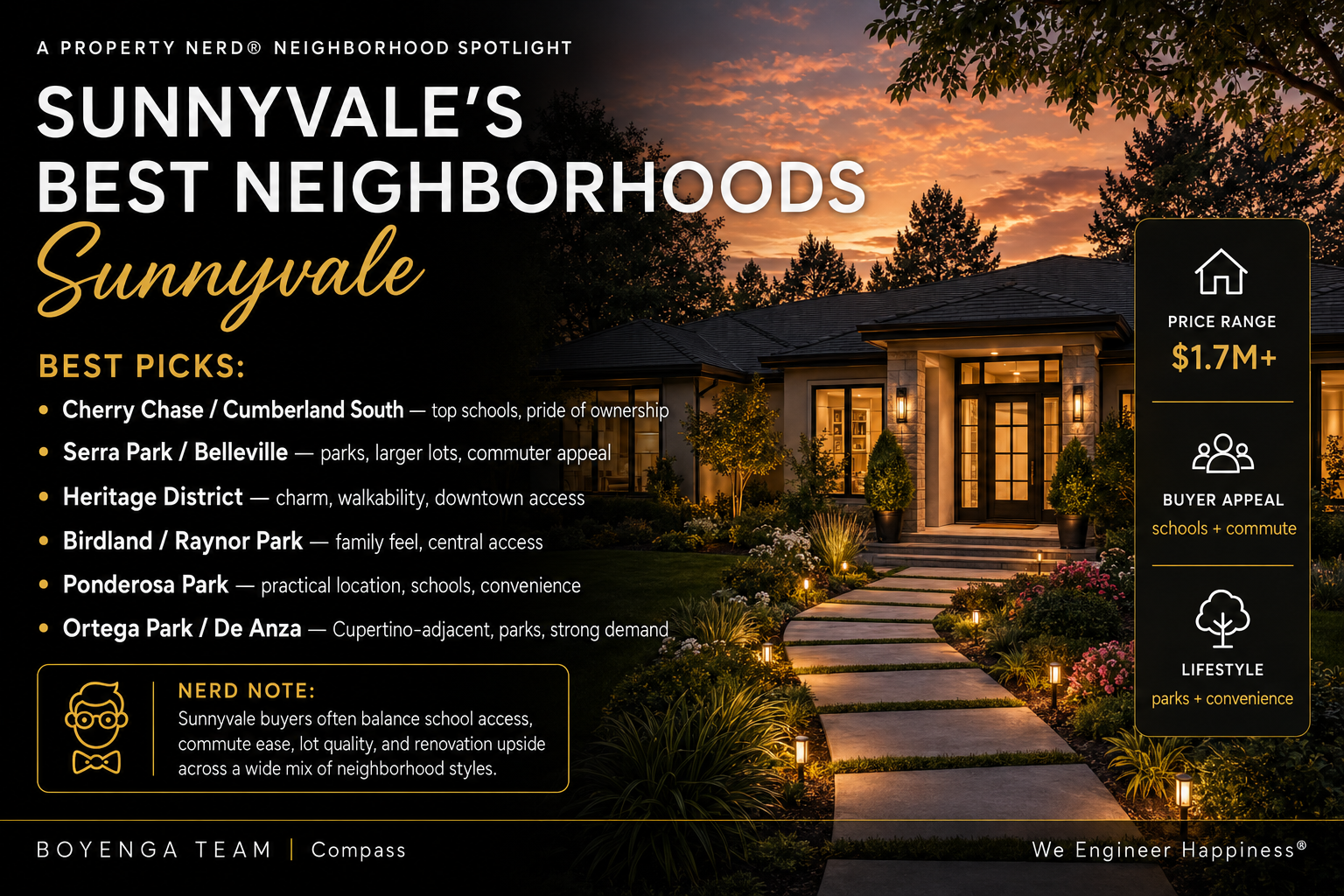
Sunnyvale is one of Silicon Valley’s most quietly powerful real estate markets. It does not always get the same prestige headlines as Palo Alto, Los Altos, or Cupertino, but smart buyers understand why Sunnyvale is such a high-demand city: strong commute access, multiple school districts, proximity to Apple and major tech employers, a mix of classic ranch homes and Eichlers, a growing downtown, and neighborhoods that can feel dramatically different from one another.
That is what makes Sunnyvale so interesting.
A buyer looking at Sunnyvale may be comparing a Cherry Chase family home, a Birdland ranch near Apple, an Eichler in Fairbrae, a downtown condo near Murphy Avenue, a Lakewood Village home near North Sunnyvale tech corridors, or a Serra Park property near the Cupertino border. All of those homes can be “Sunnyvale,” but they are not the same buyer story.
Sunnyvale is not one market. It is a collection of micro-markets shaped by schools, commute routes, housing style, street quality, lot size, remodel potential, and proximity to parks, downtown, Apple, Google, LinkedIn, Nvidia, and the 237/101/280 corridors.
The smartest way to understand Sunnyvale is not to ask, “What is the best neighborhood?”
The better question is:
What job does this neighborhood do for the buyer?
Does it deliver top school demand? Apple commute convenience? Eichler architecture? Downtown walkability? Better relative value? A classic family setting? Larger homes? Lower-maintenance townhomes? A quieter residential street? A stronger long-term resale pool?
Once you look at Sunnyvale through that lens, the neighborhood map becomes much clearer.
Why Sunnyvale Real Estate Is So Neighborhood-Sensitive
Sunnyvale real estate is heavily influenced by school boundaries, commute geometry, housing type, and proximity to major employment centers.
The west and southwest parts of Sunnyvale often attract buyers who are comparing Sunnyvale with Cupertino, Los Altos, and Mountain View. These buyers may care deeply about school assignment, lot size, neighborhood feel, and Apple proximity.
Central Sunnyvale buyers may focus on parks, access, affordability relative to the west side, and classic ranch-home neighborhoods.
Downtown Sunnyvale buyers may want restaurants, Caltrain, Murphy Avenue, CityLine, newer condos, and a more walkable lifestyle.
North Sunnyvale buyers may prioritize commute access to Google, Moffett Park, LinkedIn, Lockheed Martin, Nvidia, and the 237 corridor.
Then there are the architecture buyers: people who specifically want Eichlers, mid-century modern homes, or neighborhoods with a more distinctive design identity.
That variety is why Sunnyvale requires a neighborhood-by-neighborhood strategy. Two homes can be five minutes apart and appeal to very different buyer pools.
1. Cherry Chase / Cumberland South
Best for: schools, family buyers, classic neighborhood feel, strong resale
Cherry Chase and Cumberland South are among Sunnyvale’s most sought-after residential neighborhoods. These areas are especially popular with family buyers who want quiet streets, parks, strong school-driven demand, and a classic single-family neighborhood feel.
This part of Sunnyvale often attracts buyers who are comparing it with Cupertino, Los Altos, and Mountain View. The appeal is not just the home itself. It is the entire daily-life package: school access, neighborhood feel, commute convenience, and long-term resale confidence.
Homes are often ranch-style or remodeled single-family properties, with many buyers looking for good layouts, usable yards, natural light, and expansion potential. Because demand is strong, buyers need to be careful about overpaying for a home that needs major work unless the lot, location, and school story justify the price.
The Property Nerd read: Cherry Chase / Cumberland South is one of Sunnyvale’s most reliable family-demand pockets. The strongest homes here combine school appeal, quiet streets, functional lots, and clean remodel potential.
2. Birdland / Raynor Park
Best for: Apple commute, family buyers, remodeling upside, central-west Sunnyvale demand
Birdland, known for its bird-named streets near Raynor Park, is one of Sunnyvale’s most recognizable and desirable neighborhoods. It is especially popular with Apple-area commuters and buyers who want a strong 94087 location with classic residential appeal.
The neighborhood’s appeal is practical and emotional. It offers a real neighborhood feel, access to parks, proximity to major commute routes, and strong demand from buyers who want to be close to Apple Park, Cupertino, and west Sunnyvale amenities.
Housing is often ranch-style, with a mix of original homes, remodeled homes, and expanded properties. This creates opportunity, but it also requires careful comp analysis. A beautifully remodeled home on a quiet interior street may command a different buyer pool than an original-condition home on a busier edge.
The Property Nerd read: Birdland / Raynor Park is a commute-plus-lifestyle neighborhood. It performs best when the home offers a clean layout, useful yard, quiet street, and a credible Apple/west-side commute story.
3. Serra Park / Belleville
Best for: west Sunnyvale, larger homes, Cupertino-adjacent demand, family lifestyle
Serra Park and Belleville are among Sunnyvale’s strongest west-side neighborhoods. Buyers like the quiet residential streets, access to parks, larger home potential, and proximity to Cupertino, Los Altos, and major commute routes.
This area can feel more premium because it sits in a part of Sunnyvale that many buyers associate with strong schools, west-side convenience, and a more established suburban setting. Buyers shopping here may also be considering Cupertino and Los Altos, which can strengthen demand when Sunnyvale offers a better value equation.
Homes vary from classic ranch properties to remodeled and expanded residences. Lot size, floor plan, school assignment, and street location all matter. Buyers should look carefully at whether the home supports modern living or whether the remodel budget is significant.
The Property Nerd read: Serra Park / Belleville is one of Sunnyvale’s strongest west-side family plays. It appeals to buyers who want the Cupertino-adjacent lifestyle without necessarily buying in Cupertino.
4. Ponderosa Park
Best for: central location, classic family neighborhood, parks, commute flexibility
Ponderosa Park is a highly practical Sunnyvale neighborhood that offers a classic residential feel with central convenience. It is a strong fit for buyers who want parks, schools, shopping, and access to multiple commute routes without being locked into only one side of the city.
The neighborhood has broad buyer appeal because it is easy to live in. It is not just about prestige or one employer commute. It works for people who want balance: a residential street, a usable home, nearby amenities, and good access to the rest of Silicon Valley.
Homes are often ranch-style or updated single-family properties. Buyers should evaluate condition, layout, street quality, and whether the property offers indoor-outdoor flow. As with many Sunnyvale neighborhoods, clean updates and thoughtful presentation can make a big difference.
The Property Nerd read: Ponderosa Park is one of Sunnyvale’s best “daily life” neighborhoods. It may not be the flashiest, but it delivers the kind of practical livability buyers keep coming back to.
5. Sunnyvale Heritage District
Best for: historic charm, downtown lifestyle, walkability, character homes
The Heritage District is Sunnyvale’s character-rich downtown-adjacent neighborhood. It offers older homes, tree-lined streets, architectural variety, and proximity to Murphy Avenue, downtown restaurants, Caltrain, CityLine, and civic amenities.
This is the neighborhood for buyers who want Sunnyvale with charm. Instead of a uniform ranch tract, buyers may find older cottages, bungalows, historic homes, condos, townhomes, and infill properties.
The lifestyle appeal is strong. Buyers can enjoy downtown Sunnyvale, restaurants, cafes, farmers markets, Caltrain access, and a more walkable environment. That makes the Heritage District one of Sunnyvale’s most distinctive neighborhoods.
The trade-off is that older homes require more diligence. Buyers should pay attention to foundation, roof, electrical, plumbing, drainage, sewer, permit history, and whether additions were done properly.
The Property Nerd read: The Heritage District wins on identity. It has a sense of place that many suburban neighborhoods do not, which helps support long-term demand for the right homes.
6. Washington Park
Best for: downtown access, Caltrain, classic Sunnyvale charm, central convenience
Washington Park is another strong downtown-adjacent Sunnyvale neighborhood. It offers proximity to Washington Park, the Sunnyvale Caltrain station, downtown Sunnyvale, restaurants, and shopping.
This area appeals to buyers who want walkability and central access but may prefer a slightly more residential feel than being directly in the middle of downtown. It can work well for buyers who commute by train, value nearby parks, or want to be close to Sunnyvale’s growing urban core.
Housing can include older single-family homes, remodeled properties, condos, and townhomes depending on the exact location. Buyers should evaluate road exposure, parking, property condition, and how close the home is to Caltrain or busier corridors.
The Property Nerd read: Washington Park is a lifestyle-and-access neighborhood. It is especially compelling when the home balances walkability with a calm residential feel.
7. Las Palmas / Sunnymount
Best for: parks, central Sunnyvale, family living, practical convenience
Las Palmas and Sunnymount offer a strong central Sunnyvale lifestyle anchored by Las Palmas Park, one of the city’s most beloved park spaces. Buyers like the neighborhood feel, access to recreation, and central location.
This area is especially good for buyers who want everyday livability. Parks, shopping, schools, and commute routes are all part of the appeal.
Homes tend to be classic Sunnyvale ranch-style or updated single-family properties, with some variation by block. Buyers should focus on street quality, lot usability, floor plan, and remodel level.
The Property Nerd read: Las Palmas / Sunnymount is a comfort neighborhood. It delivers parks, convenience, and residential feel in a way that works for a wide range of buyers.
8. Fairbrae / Fairbrae Eichler Area
Best for: Eichler buyers, mid-century modern design, architectural identity
Fairbrae is one of Sunnyvale’s most important neighborhoods for mid-century modern and Eichler buyers. Sunnyvale has a significant Eichler presence, and Fairbrae is one of the key areas for buyers who want that indoor-outdoor, post-and-beam, glass-wall, atrium lifestyle.
This is a very different buyer psychology from a traditional ranch-home neighborhood. Eichler buyers often care about architecture, light, originality, slab radiant heat, roof systems, mahogany paneling, globe lights, open-air atriums, and design integrity.
For the right buyer, an Eichler is not just a house. It is a lifestyle and design statement.
The trade-off is maintenance and specialization. Buyers should understand foam or membrane roof systems, radiant heat, slab foundations, glass exposure, insulation limitations, original electrical, drainage, and whether updates have respected the architecture.
The Property Nerd read: Fairbrae is Sunnyvale’s design-lover neighborhood. When an Eichler is authentic, well-maintained, and thoughtfully improved, it can attract a passionate buyer pool.
9. Lakewood Village / Fairwood
Best for: North Sunnyvale access, relative value, tech commute, practical entry point
Lakewood Village and Fairwood are important because they represent a more practical North Sunnyvale story. These neighborhoods offer access to Moffett Park, Google, LinkedIn, Lockheed Martin, Nvidia, Highway 237, Highway 101, and the broader North Bayshore employment corridor.
Buyers here may prioritize commute and value more than prestige or school-driven demand. For some, Lakewood and Fairwood offer a way into Sunnyvale single-family living at a more approachable price point compared with west Sunnyvale.
The neighborhood feel can vary, so buyers should evaluate exact street, road exposure, property condition, and proximity to commercial or industrial uses. Some pockets feel very residential, while others are more commute-and-access oriented.
The Property Nerd read: Lakewood Village / Fairwood is a practical tech-commute play. It can be compelling for buyers who want Sunnyvale access and relative value, especially if the home is well-positioned on a good street.
10. Ortega Park / De Anza
Best for: west Sunnyvale convenience, Apple access, Cupertino border demand
The Ortega Park / De Anza area is a strong west Sunnyvale pocket for buyers who want access to Cupertino, Apple, parks, and commute routes. It is especially attractive to buyers who care about the west-side Silicon Valley map.
This area can appeal to families, tech professionals, and buyers who want a residential neighborhood near high-demand employment and amenities.
Homes are often single-family properties, with a mix of original, remodeled, and expanded homes. Buyers should pay attention to school assignment by exact address, lot utility, road exposure, and whether the home has modernized systems.
The Property Nerd read: Ortega Park / De Anza is a location-smart neighborhood. It is valuable because it connects buyers to Cupertino, Apple, and west Sunnyvale convenience.
11. Morse Park
Best for: central access, value, first-time single-family buyers, practical lifestyle
Morse Park is a practical central Sunnyvale neighborhood that can appeal to buyers looking for access, relative value, and a residential setting. It may be especially interesting to first-time single-family buyers or people priced out of more expensive west-side pockets.
This area is less about prestige and more about function. Buyers may choose it because it gives them Sunnyvale access, neighborhood streets, and proximity to parks and commute routes at a relatively better value.
As with other practical neighborhoods, exact location matters. Buyers should compare street quality, condition, lot usability, and nearby road exposure.
The Property Nerd read: Morse Park can be a smart buyer-fit neighborhood when the property has good fundamentals and is priced against the correct competitive set.
12. Snail / Lowlanders
Best for: unique neighborhood identity, central location, downtown access
The Snail and Lowlanders areas are smaller, locally distinctive Sunnyvale pockets. They appeal to buyers who want something a little less generic and more connected to the city’s central fabric.
These neighborhoods can offer access to downtown, parks, schools, and commute routes while still having a local neighborhood identity. They may not have the broad name recognition of Cherry Chase or Birdland, but they matter in a comprehensive Sunnyvale guide.
Buyers should evaluate each property carefully because housing stock and street quality can vary. These areas can include older homes, updated homes, and properties with varying levels of remodel potential.
The Property Nerd read: Snail / Lowlanders is for buyers who like hyper-local neighborhoods with character and central convenience.
13. Downtown Sunnyvale / CityLine
Best for: restaurants, shopping, Caltrain, condos, townhomes, urban convenience
Downtown Sunnyvale and CityLine represent the city’s more urban, walkable future. This area appeals to buyers who want restaurants, shopping, Caltrain, entertainment, newer housing, and a lower-maintenance lifestyle.
This is not the same buyer as someone looking for a large ranch home in Cherry Chase or an Eichler in Fairbrae. Downtown buyers may be professionals, downsizers, investors, or people who prefer convenience over yard space.
The strength of Downtown Sunnyvale is lifestyle. Murphy Avenue, Caltrain, CityLine, cafes, restaurants, and shopping create an urban-suburban hybrid that is increasingly attractive in Silicon Valley.
For condo and townhome buyers, HOA due diligence is essential. Buyers should evaluate dues, reserves, insurance, litigation, rental restrictions, parking, guest parking, storage, and upcoming maintenance needs.
The Property Nerd read: Downtown Sunnyvale / CityLine is the convenience lane. It is strongest for buyers who want walkability, access, and low-maintenance living.
14. East Murphy / West Murphy
Best for: downtown-adjacent living, historic access, restaurants, walkability
East Murphy and West Murphy are closely tied to the downtown Sunnyvale experience. These areas appeal to buyers who want to be near Murphy Avenue, restaurants, Caltrain, and the city’s historic commercial core.
Housing can vary from older homes to condos, townhomes, and infill properties. The strongest locations balance downtown access with livability. Too close to noise or traffic may not work for every buyer, but being within easy reach of restaurants and transit can be a major advantage.
The Property Nerd read: East Murphy / West Murphy is all about lifestyle proximity. The best properties here let buyers enjoy downtown without sacrificing too much privacy or calm.
15. Gavello Glen
Best for: smaller residential pocket, central convenience, local neighborhood feel
Gavello Glen is a smaller Sunnyvale neighborhood that can be useful to include in a comprehensive guide because it represents the kind of pocket buyers may not know by name but may appreciate once they experience it.
This area can offer central access, residential streets, and practical convenience. It may appeal to buyers who want Sunnyvale living without focusing only on the biggest-name neighborhoods.
The key is property-level evaluation. Buyers should look closely at condition, floor plan, street feel, and commute routes.
The Property Nerd read: Gavello Glen is a reminder that not every good Sunnyvale neighborhood has to be famous. Sometimes the right block, right home, and right price matter more than the neighborhood brand.
How to Think About Sunnyvale by Buyer Type
Best for school-driven demand
Cherry Chase, Cumberland South, Serra Park, Ortega Park / De Anza, select west Sunnyvale pockets
These areas often attract buyers who prioritize school assignment, family lifestyle, and long-term resale confidence.
Best for Apple commute access
Birdland / Raynor Park, Ortega Park / De Anza, Cherry Chase, Rancho-adjacent west Sunnyvale pockets
These neighborhoods are especially practical for buyers who work near Apple Park, Cupertino, or the west-side tech corridor.
Best for classic family living
Cherry Chase, Ponderosa Park, Las Palmas / Sunnymount, Serra Park, Birdland
These areas offer parks, residential streets, single-family homes, and broad buyer appeal.
Best for Eichler and mid-century modern buyers
Fairbrae, Fairorchard, Sunnyvale Eichler pockets
These neighborhoods appeal to buyers who value architecture, indoor-outdoor living, atriums, radiant heat, and mid-century design.
Best for downtown walkability
Heritage District, Washington Park, Downtown Sunnyvale, CityLine, East Murphy, West Murphy
These areas are strong for buyers who want restaurants, Caltrain, shopping, and a more walkable Silicon Valley lifestyle.
Best for relative value and tech commute
Lakewood Village, Fairwood, Morse Park, North Sunnyvale pockets
These neighborhoods can offer more practical entry points, especially for buyers focused on access to 237, 101, Moffett Park, and North Bayshore.
Best for central convenience
Ponderosa Park, Las Palmas / Sunnymount, Morse Park, Gavello Glen, Snail / Lowlanders
These areas offer practical Sunnyvale living without relying only on prestige or school-driven demand.
Sunnyvale Neighborhoods and Housing Types
One of the most important things to understand about Sunnyvale is that housing type can change the buyer pool dramatically.
A Sunnyvale property might be:
A classic ranch home in Cherry Chase.
A remodeled Apple-adjacent home in Birdland.
An Eichler in Fairbrae.
A downtown condo near CityLine.
A townhome near Caltrain.
A North Sunnyvale home near 237.
A larger west-side property near Serra Park.
A central Sunnyvale fixer with remodel potential.
Those properties should not be evaluated the same way.
For single-family homes, buyers should focus on lot size, floor plan, orientation, usable yard space, school assignment, street quality, expansion potential, and remodel quality.
For older ranch homes, buyers should review foundation, electrical, plumbing, roof, drainage, sewer lateral, termite, insulation, windows, and permit history.
For Eichlers, buyers should pay special attention to roof system, slab radiant heat, drainage, glass, original materials, electrical, waterproofing, and whether updates preserved the architectural integrity.
For condos and townhomes, buyers should evaluate HOA dues, reserves, insurance, litigation, rental restrictions, parking, storage, exterior maintenance obligations, and upcoming capital projects.
For downtown properties, buyers should think about noise, parking, transit access, walkability, HOA health, and long-term demand for urban-style Sunnyvale living.
The Property Nerd Bottom Line
Sunnyvale is one of Silicon Valley’s most strategic real estate cities because it offers so many different ways to win.
Cherry Chase and Cumberland South deliver school-driven family demand. Birdland / Raynor Park brings Apple commute convenience and classic residential appeal. Serra Park and Belleville offer west-side strength and Cupertino-adjacent demand. Ponderosa Park and Las Palmas / Sunnymount provide everyday family livability. The Heritage District, Washington Park, Murphy Avenue, Downtown Sunnyvale, and CityLine create the city’s walkable lifestyle story. Fairbrae and other Eichler pockets attract design-focused buyers. Lakewood Village, Fairwood, Morse Park, and North Sunnyvale offer practical commute access and relative value.
The smartest Sunnyvale buyers do not just ask, “Is this a good neighborhood?”
They ask:
What buyer pool will want this home when I sell?
Is the value driven by schools, Apple access, architecture, commute, or lifestyle?
Is the street quiet enough?
Is the lot usable?
Is the floor plan fixable?
Is this home priced for its condition?
Does the neighborhood support the future value of the property?
Is this a school purchase, a commute purchase, an architecture purchase, a lifestyle purchase, or a value purchase?
That is how you understand Sunnyvale.
For sellers, the lesson is just as important. A Cherry Chase home should not be marketed the same way as a Fairbrae Eichler. A Birdland home needs a different story than a Downtown Sunnyvale condo. A Lakewood Village home needs to be positioned differently than a Serra Park property. A Heritage District bungalow needs different marketing than a Ponderosa Park ranch.
In Sunnyvale, the neighborhood story matters. The school assignment matters. The commute matters. The architecture matters. The lot matters. The street matters. The future buyer pool matters.
That is why Sunnyvale remains one of Silicon Valley’s most durable and high-demand real estate markets — not because every neighborhood is the same, but because each one gives buyers a different way to plug into the Silicon Valley lifestyle.