

Blog > Best Santa Clara Neighborhoods: A Property Nerds Guide to Where to Live in Santa Clara, CA
Best Santa Clara Neighborhoods: A Property Nerds Guide to Where to Live in Santa Clara, CA
by
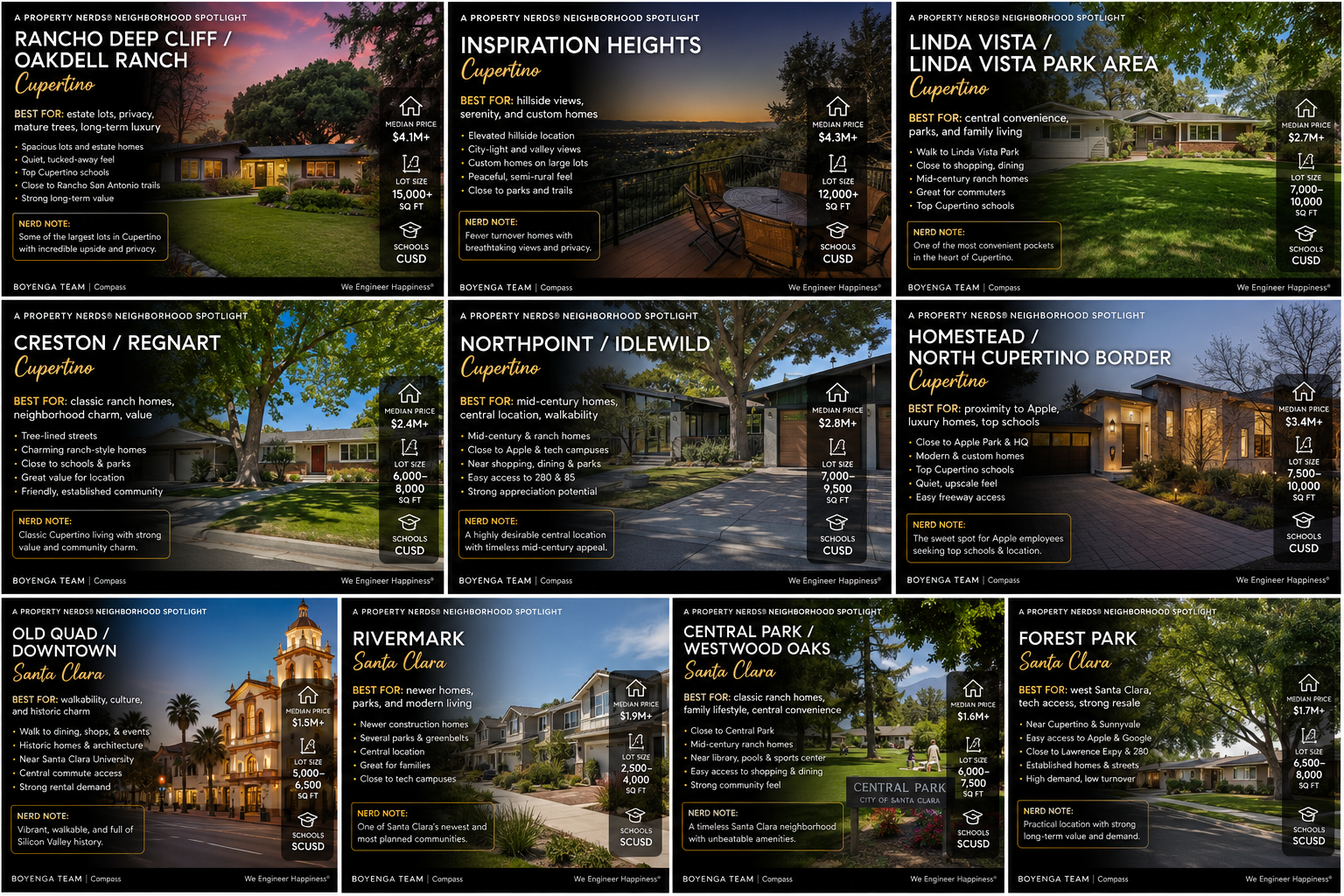
Santa Clara is one of Silicon Valley’s most interesting real estate markets because it does not behave like a one-note city. It is not just a “school district city,” not just a “tech commute city,” and not just a “historic downtown city.” Santa Clara is a grid-and-corridor market where value shifts block by block based on commute geometry, housing type, school assignment, road exposure, lot utility, utility costs, and proximity to major employment centers.
That is what makes Santa Clara fascinating.
A buyer looking at Santa Clara may be comparing a historic bungalow near the Old Quad, a newer townhome in Rivermark, a classic ranch near Central Park, a west-side single-family home near Apple commute routes, or a Northside condo near Nvidia, Intel, Levi’s Stadium, and the 237 corridor. All of those properties can be “Santa Clara,” but they serve completely different buyer profiles.
For buyers, sellers, trustees, and relocating tech families, understanding Santa Clara neighborhoods is not just about knowing which areas are “nice.” It is about understanding what each pocket does well, what trade-offs come with the location, and how each micro-market competes for demand.
Why Santa Clara Real Estate Is So Micro-Neighborhood Driven
Santa Clara sits in the middle of Silicon Valley’s employment engine. It borders or connects easily to San Jose, Sunnyvale, Cupertino, Mountain View, and North San Jose. That means buyers often choose Santa Clara for access: access to Apple, Nvidia, Intel, Google routes, Santa Clara University, Levi’s Stadium, Valley Fair/Santana Row, Lawrence Expressway, San Tomas Expressway, Central Expressway, 101, 237, 280, and 880.
But Santa Clara is also unusually varied.
You have historic streets near Santa Clara University. You have mid-century ranch neighborhoods near Central Park. You have newer planned-community housing in Rivermark. You have practical condo and townhome corridors along El Camino Real and Scott Boulevard. You have west-side neighborhoods that feel more connected to Sunnyvale and Cupertino. And you have Northside growth zones shaped by tech campuses, transit, stadium traffic, and high-density housing.
That is why Santa Clara buyers should not shop by city name alone. They should shop by neighborhood function.
The big Property Nerd question is this:
What job is this neighborhood doing for the buyer?
Is it giving them charm? Commute? Schools? Newer construction? Lower maintenance? Lot size? Resale stability? Tech access? Relative value?
Once you know that, Santa Clara becomes much easier to understand.
1. Old Quad / Downtown Santa Clara
Best for: historic charm, Santa Clara University proximity, character homes, walkability
Old Quad is one of Santa Clara’s most recognizable and emotionally resonant neighborhoods. This is where buyers find older homes, tree-lined streets, historic character, and a sense of place that feels different from the more suburban ranch-home neighborhoods elsewhere in the city.
The area is closely tied to Santa Clara University, Mission Santa Clara, Franklin Square, and the older civic heart of the city. Housing can include bungalows, cottages, Victorians, early twentieth-century homes, apartments, condos, and infill development.
Old Quad is ideal for buyers who want character and walkability more than a perfectly uniform suburban tract. It appeals to people who like older homes, front porches, mature trees, university energy, and the idea of living near Santa Clara’s historic core.
The trade-off is that older homes can require more diligence. Buyers should pay close attention to foundation condition, electrical systems, plumbing, roof age, drainage, lot configuration, additions, permit history, and parking. Some properties have been beautifully restored. Others may need significant updating.
From a resale perspective, Old Quad benefits from scarcity and identity. It is one of the few Santa Clara neighborhoods with a true historic-neighborhood feel. That identity matters.
2. Rivermark
Best for: newer homes, planned-community living, Northside tech commute, lower-maintenance lifestyle
Rivermark is Santa Clara’s most important planned-community neighborhood. It offers a very different product from Old Quad or Central Santa Clara: newer homes, townhomes, condos, parks, retail, a school, library access, and a more organized master-planned feel.
For many tech buyers, Rivermark is compelling because it combines newer construction with excellent access to North San Jose, Nvidia, Intel, Cisco, Oracle-area employment, the 237 corridor, and broader Silicon Valley commute routes.
The neighborhood has a more polished, cohesive feel than many older Santa Clara pockets. Buyers like the sidewalks, neighborhood retail, parks, and the ability to get a newer home without the same maintenance profile as a 1950s ranch or 1920s bungalow.
The trade-off is density and sameness. Rivermark does not have the older-home character of Old Quad or the larger-lot feel of some west-side neighborhoods. Some buyers love the planned-community structure; others prefer more architectural individuality.
From a resale standpoint, Rivermark is one of Santa Clara’s most liquid neighborhoods because it serves a very clear buyer pool: tech professionals who want newer housing, commute convenience, and a predictable neighborhood experience.
3. Central Park / Westwood Oaks
Best for: classic Santa Clara ranch homes, family lifestyle, parks, central convenience
The Central Park and Westwood Oaks areas represent classic Santa Clara living. These neighborhoods are known for residential streets, mid-century ranch homes, proximity to Central Park, the Santa Clara City Library, International Swim Center, shopping, and everyday conveniences.
This is the Santa Clara buyer who wants a traditional neighborhood rather than an urban corridor or master-planned community. Homes are often single-story or expanded ranch-style properties, with layouts that may work well for families, remodelers, and buyers who appreciate practical lot use.
Central Park is a major lifestyle anchor. Having a large park, library, swim center, sports fields, and community amenities nearby gives this area a strong everyday-living advantage.
The Property Nerd angle here is lot and layout. Many ranch homes in this area can be strong candidates for remodeling, expansion, or reconfiguration, but the value depends on the existing footprint, orientation, setbacks, garage placement, roofline, and how the home relates to the backyard.
For sellers, this area can perform well when the home is properly prepared. Buyers often respond strongly to clean design, updated kitchens and baths, indoor-outdoor flow, natural light, and a yard that feels usable.
4. Forest Park
Best for: west Santa Clara, Apple-area access, Sunnyvale/Cupertino convenience, strong practical demand
Forest Park is one of Santa Clara’s stronger west-side neighborhoods because of its location. It sits in a highly practical part of the city for buyers who want access to Sunnyvale, Cupertino, Apple-area employment, Lawrence Expressway, Stevens Creek Boulevard, and major commute routes.
This is not always the first neighborhood name buyers know when they begin searching Santa Clara, but it often becomes more attractive once they start mapping their commute and comparing prices to nearby Cupertino and Sunnyvale pockets.
Forest Park buyers are often practical and location-sensitive. They want a single-family neighborhood, but they also care about how quickly they can get to work, school, shopping, and major roads.
The homes are generally more suburban and mid-century in feel, with remodel potential depending on the individual property. As with many Santa Clara neighborhoods, road exposure and exact block quality matter. A quiet interior street can feel very different from a home closer to a heavier traffic route.
Forest Park is a good example of Santa Clara’s “useful value” story: not always the flashiest brand name, but very functional and often very compelling.
5. Laurelwood
Best for: quiet residential feel, west-side convenience, commute access
Laurelwood is another west Santa Clara neighborhood that appeals to buyers who want residential calm with strong regional access. It offers a quieter neighborhood feel while still being connected to Lawrence Expressway, Central Expressway, Sunnyvale, Apple, and the broader west-side employment base.
This area tends to work well for buyers who value practicality. They may not need historic charm or newer construction. They want a clean, well-located neighborhood with good access and a more settled suburban rhythm.
From a real estate perspective, Laurelwood’s strength is its balance. It can serve owner-occupant buyers, families, and commuters without depending on one single demand driver.
For sellers, presentation matters. In neighborhoods like Laurelwood, buyers often compare homes based on condition, floor plan, lot usability, road noise, and remodel quality. A well-prepared home can stand out quickly.
6. Santa Clara Woods
Best for: established streets, classic single-family homes, central-west location
Santa Clara Woods is a strong residential pocket for buyers who want an established neighborhood, classic single-family homes, and convenient access to parks, shopping, and commute corridors.
This is one of those neighborhoods that often appeals more in person than on paper. It may not have the headline recognition of Rivermark or Old Quad, but it delivers the stable, suburban Santa Clara lifestyle many buyers are actually looking for.
The key value factors here are lot utility, home condition, street feel, and proximity to amenities. Buyers should look closely at whether the home has been expanded thoughtfully or whether additions have created awkward flow.
Santa Clara Woods can be especially appealing for buyers who want a move-up single-family home without going into the most expensive west-valley markets.
7. Mariposa Gardens
Best for: family buyers, ranch homes, central location, neighborhood feel
Mariposa Gardens is a useful neighborhood to include in any Santa Clara guide because it captures the everyday family-home market. It has a practical central location, ranch-style housing stock, and a residential feel that appeals to buyers who want a straightforward Silicon Valley home base.
This is not necessarily a “trophy neighborhood,” but it is the kind of area where real buyers can make real life work. Access to parks, schools, shopping, and commute routes gives it broad appeal.
The Property Nerd lens here is condition versus upside. Some homes may be updated and turnkey, while others may be candidates for renovation. Buyers should compare price against the cost of bringing systems, finishes, and layout up to current expectations.
Mariposa Gardens can be a strong fit for buyers who want Santa Clara convenience without chasing the most premium pocket in the city.
8. Bowers / Bowers Park Area
Best for: commute access, practical location, value relative to west Santa Clara
The Bowers area is one of Santa Clara’s more practical commute-driven neighborhoods. It offers access to Bowers Avenue, Central Expressway, San Tomas Expressway, and major employment centers.
This pocket is often about utility more than romance. It may not have the historic appeal of Old Quad or the planned-community polish of Rivermark, but it can make a lot of sense for buyers who prioritize commute, budget, and access.
Housing can vary, so buyers should be careful about exact location, road exposure, nearby commercial uses, and overall block feel. In Santa Clara, one or two blocks can meaningfully change how a property feels.
For investors and first-time buyers, Bowers can be worth watching because it may offer relative affordability compared with stronger west-side pockets. For sellers, pricing strategy matters because buyers in practical zones tend to be very comparison-driven.
9. Northside / Great America / Tasman
Best for: tech campuses, Levi’s Stadium, transit, newer density, urban growth
Northside Santa Clara is one of the city’s most dynamic areas. It is shaped by tech campuses, Levi’s Stadium, Great America, light rail, office parks, apartments, condos, townhomes, and ongoing growth around the Tasman and North First Street corridors.
This is not classic single-family Santa Clara. It is more urban, more employment-driven, and more infrastructure-heavy. Buyers here are often looking for commute convenience, newer housing, transit access, and proximity to major companies.
The trade-offs are important. Stadium events, traffic patterns, density, parking, and commercial surroundings can all affect daily life. Some buyers love the energy and convenience. Others prefer quieter, older residential neighborhoods.
From a long-term perspective, Northside is one of Santa Clara’s major growth stories. It is especially relevant for buyers who believe in the continued expansion of Silicon Valley employment near the 237 corridor.
10. Mission Park / Mission Gardens
Best for: central location, Santa Clara University access, mixed housing
Mission Park and Mission Gardens are central Santa Clara pockets with access to Santa Clara University, El Camino Real, local services, and commute routes. These areas can include a mix of older homes, apartments, condos, and townhomes.
This is a good area for buyers who want central Santa Clara but may not need the full Old Quad charm premium. It can also be relevant for investors, university-adjacent buyers, and people who want access to both Santa Clara and San Jose.
Because housing type varies, buyers need to evaluate each property carefully. A single-family home, condo, or townhome in this area may appeal to a very different buyer pool.
The key questions are: How close is it to traffic? How functional is the property? Is the block primarily residential or mixed-use? What is the parking situation? What is the long-term rental or resale profile?
11. Agnew / Agnews Area
Best for: Northside access, Rivermark spillover, employment proximity
The Agnew/Agnews area is important because it connects Santa Clara’s older institutional history with the city’s newer Northside growth. It sits near Rivermark, North First Street, major tech corridors, and commute routes.
This area can be appealing to buyers who want access to Northside employment but may be looking outside the most branded Rivermark product. It can also work for buyers who are comfortable with a more transitional or mixed-use environment.
As with Northside, buyers should pay attention to traffic, density, nearby land uses, and the exact housing product. Some properties may feel very residential. Others may feel more urban or employment-adjacent.
The upside is location. For buyers working nearby, the convenience can be powerful.
12. Koreatown / El Camino Corridor
Best for: restaurants, services, mixed housing, central access
The El Camino Real corridor is one of Santa Clara’s most active lifestyle and commercial zones. It is not always a “neighborhood” in the classic single-family sense, but it is a major part of how Santa Clara functions.
The Koreatown / El Camino area offers restaurants, shopping, services, apartments, condos, townhomes, and nearby residential streets. It can appeal to buyers who want central access, food options, transit corridors, and relative affordability compared with more purely residential pockets.
The trade-off is corridor living. Buyers should consider noise, parking, density, traffic, and walkability quality. Being near El Camino can be convenient, but not all blocks feel equally residential.
For investors, this area can be interesting because mixed housing and central access may support rental demand. For owner-occupants, the key is finding the right balance between convenience and livability.
13. Pruneridge / Monroe Area
Best for: central-west convenience, Apple commute, everyday practicality
The Pruneridge / Monroe area is a very useful Santa Clara pocket for buyers who care about access. It connects well to Pruneridge Avenue, Stevens Creek Boulevard, San Tomas Expressway, Lawrence Expressway, and Apple-area employment.
This is a practical neighborhood zone rather than a heavily branded one. Buyers may choose it because it shortens their commute, gives them access to west Santa Clara and Cupertino/Sunnyvale amenities, and offers a mix of housing options.
The Property Nerd read: this area is about convenience math. How quickly can you get to work? How close are you to shopping and services? Is the street quiet enough? Does the home have the layout and lot utility to justify the price?
For sellers, this kind of neighborhood benefits from clear positioning. The marketing should not just say “great location.” It should explain what the location actually does: Apple access, west-side convenience, commute flexibility, and everyday practicality.
14. El Camino / Scott Boulevard Area
Best for: affordability, access, condos, townhomes, mixed housing
The El Camino / Scott Boulevard area is another practical Santa Clara zone. It offers access to major corridors, a mix of apartments, condos, townhomes, and nearby single-family streets.
This area often appeals to buyers looking for Santa Clara access without paying for the most premium residential pockets. It can be a good fit for first-time buyers, investors, commuters, and people who want central access more than a quiet suburban setting.
Because housing type varies so much, comps must be handled carefully. Condo, townhome, and single-family values can behave differently even within a small radius. HOA dues, parking, condition, building age, and road exposure all matter.
This is a strong example of Santa Clara’s “buyer segmentation” market. The right property can make sense, but it needs to be evaluated against the correct buyer pool.
15. Warburton / Civic Center Area
Best for: central Santa Clara, city services, Old Quad-adjacent living
The Warburton / Civic Center area sits near Santa Clara’s civic core, Old Quad, Santa Clara University, El Camino Real, and city services. It can be appealing for buyers who like central Santa Clara but want to evaluate a wider range of property types and price points.
This area can offer convenient access without necessarily being in the most premium Old Quad blocks. It may include older homes, multifamily, condos, and transitional pockets depending on the exact location.
The key is block-by-block evaluation. Some streets may feel charming and residential, while others may be more affected by traffic or nearby commercial uses.
For buyers who want centrality, Warburton/Civic Center can be a smart area to understand. For sellers, the marketing should emphasize proximity, convenience, and Old Quad-adjacent lifestyle while being realistic about property type and condition.
How to Think About Santa Clara by Buyer Type
Best for historic character
Old Quad, Downtown Santa Clara, Warburton/Civic Center
These areas appeal to buyers who want history, charm, older homes, and a more established sense of place.
Best for newer planned-community living
Rivermark
Rivermark is the clearest fit for buyers who want newer housing, sidewalks, parks, retail, and a master-planned experience.
Best for classic family neighborhoods
Central Park, Westwood Oaks, Mariposa Gardens, Santa Clara Woods
These areas offer the traditional Santa Clara ranch-home lifestyle: parks, yards, single-family streets, and central convenience.
Best for west-side commute and Apple access
Forest Park, Laurelwood, Pruneridge/Monroe
These neighborhoods are especially practical for buyers who want access to Sunnyvale, Cupertino, Apple, Lawrence Expressway, and Stevens Creek Boulevard.
Best for Northside tech access
Rivermark, Northside, Agnew, Great America/Tasman
These areas serve buyers who work near the 237 corridor, North San Jose, Nvidia, Intel, and major tech campuses.
Best for relative value and practical access
Bowers, El Camino/Scott, Mission Park, Agnew
These pockets may offer more accessible entry points depending on property type, condition, and exact location.
Best for restaurant and corridor convenience
Koreatown / El Camino Corridor
This area is strong for buyers who want food, services, central access, and a more mixed-use lifestyle.
Santa Clara Neighborhoods and Housing Types
One of the biggest mistakes buyers make in Santa Clara is comparing neighborhoods without comparing product type.
A Santa Clara property might be:
- A historic bungalow near Old Quad
- A 1950s ranch near Central Park
- A remodeled west-side single-family home
- A Rivermark townhome
- A Northside condo
- A corridor-adjacent multifamily property
- A fixer with expansion potential
- A rebuilt or heavily remodeled home on an older lot
These properties should not be evaluated the same way.
For a single-family home, buyers should focus on lot size, layout, setbacks, expansion potential, street quality, road exposure, schools, systems, roof, foundation, and remodel quality.
For a condo or townhome, buyers should focus on HOA health, dues, reserves, insurance, parking, rental restrictions, litigation, special assessments, and future maintenance obligations.
For an older home, buyers should look closely at electrical, plumbing, drainage, foundation, roof, sewer lateral, termite, permit history, and whether improvements were done properly.
For a newer planned-community home, buyers should evaluate HOA rules, density, parking, layout, storage, outdoor space, and long-term buyer demand.
The Property Nerd Bottom Line
Santa Clara is not a simple “best neighborhood” city. It is a city of buyer-fit neighborhoods.
Old Quad wins for charm. Rivermark wins for newer planned-community convenience. Central Park and Westwood Oaks win for classic Santa Clara living. Forest Park and Laurelwood win for west-side commute practicality. Northside and Agnew win for tech access and growth. El Camino, Scott Boulevard, Mission Park, and Bowers offer practical entry points and value opportunities. Koreatown and the El Camino corridor bring food, services, and central convenience.
The smartest Santa Clara buyers do not just ask, “Is this a good neighborhood?”
They ask:
- What buyer pool will want this home when I sell?
- Is the value driven by charm, commute, schools, housing type, or scarcity?
- Is the street quiet enough?
- Is the lot useful?
- Is the floor plan fixable?
- Are there road, corridor, or density issues?
- Does the property compete with single-family homes, townhomes, condos, or investment property?
- Is this a lifestyle purchase, a commute purchase, or a value purchase?
That is how you understand Santa Clara.
It is not one market. It is a collection of micro-markets sitting in the middle of Silicon Valley’s most important commute and employment corridors.
For buyers, that creates opportunity. For sellers, it means positioning matters. And for anyone trying to make a smart real estate decision in Santa Clara, the neighborhood story needs to be told with precision.