

Blog > Best Palo Alto Neighborhoods: A Property Nerds Guide to Where to Live in Palo Alto, CA
Best Palo Alto Neighborhoods: A Property Nerds Guide to Where to Live in Palo Alto, CA
by
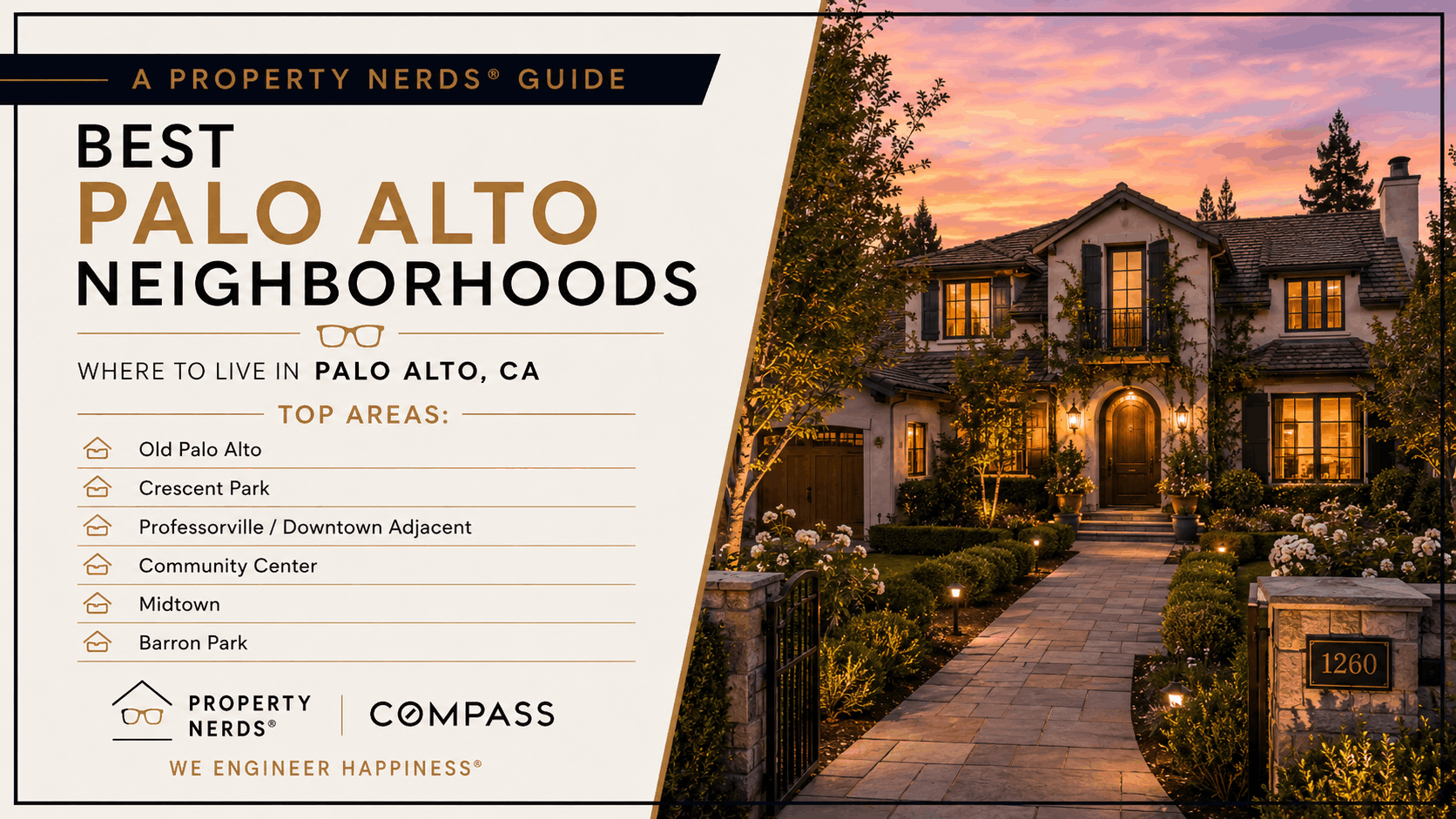
Palo Alto is one of Silicon Valley’s most iconic real estate markets. It is globally recognized for Stanford University, tree-lined streets, elite schools, historic homes, tech-founder energy, venture capital proximity, downtown lifestyle, and some of the most valuable residential real estate in the Bay Area.
But Palo Alto is not one simple market.
A buyer looking at Palo Alto may be comparing a grand estate in Old Palo Alto, a historic home in Professorville, a luxury property in Crescent Park, a family home in Green Gables, a ranch home in Midtown, an Eichler in Greenmeadow, a creekside property in Barron Park, a Stanford-adjacent home near College Terrace, or a more accessible South Palo Alto property near Charleston, Meadow, or Adobe Creek.
All of those homes can be “Palo Alto,” but they are not the same buyer story.
Palo Alto is a micro-neighborhood market shaped by school assignment, lot size, architectural pedigree, proximity to Stanford, commute direction, downtown access, tree canopy, flood zone considerations, historic overlays, remodel potential, and the future buyer pool.
That is why the Property Nerds of the Boyenga Team study Palo Alto at the block level. In Palo Alto, value is not just about square footage or zip code. It is about the neighborhood story, the street, the lot, the home’s era, the school path, the expansion potential, and how future buyers will emotionally respond to the property.
The smartest way to understand Palo Alto is not to ask, “What is the best neighborhood?”
The better question is:
What job does this neighborhood do for the buyer?
Does it deliver prestige? walkability? Stanford proximity? historic charm? top schools? larger lots? Eichler architecture? privacy? downtown energy? a quieter family setting? commute access? remodel upside? long-term legacy value?
Once you look at Palo Alto through that lens, the neighborhood map becomes much clearer.
Why Palo Alto Real Estate Is So Neighborhood-Sensitive
Palo Alto real estate is one of the most nuanced markets in Silicon Valley because buyer demand is deep, but not uniform.
Some buyers want Old Palo Alto because of legacy prestige, estate presence, and proximity to Stanford.
Some want Crescent Park for privacy, larger homes, and a refined residential feel.
Some want Professorville because of historic architecture, charm, and downtown access.
Some want Community Center because it offers walkability, schools, parks, and a central Palo Alto lifestyle.
Some want Green Gables or Duveneck/St. Francis because of classic family living and a quieter residential setting.
Some want Midtown because of practicality, schools, shopping, and more approachable single-family options compared with the most expensive northern neighborhoods.
Some want South Palo Alto because it offers Eichlers, parks, larger single-level ranch homes, and better relative value within Palo Alto.
Some want Barron Park because it feels more organic, creative, and less polished than the city’s most formal neighborhoods.
Some want College Terrace because of Stanford proximity and walkability.
The neighborhood matters because the buyer pool changes. A Professorville buyer may care about history and character. A Greenmeadow buyer may care about Eichler authenticity. A Midtown buyer may care about daily convenience. An Old Palo Alto buyer may care about legacy, land, and prestige. A South Palo Alto buyer may care about value, schools, and commute access.
In Palo Alto, the details are the market.
1. Old Palo Alto
Best for: prestige, legacy estates, Stanford proximity, architectural pedigree
Old Palo Alto is one of the most prestigious neighborhoods in Silicon Valley. It is known for grand historic homes, estate-quality properties, tree-lined streets, architectural significance, and proximity to Stanford University, downtown Palo Alto, and California Avenue.
This is the neighborhood many luxury buyers picture when they think of legacy Palo Alto. The appeal is not just the home. It is the sense of place: mature landscaping, large lots in many pockets, timeless architecture, and a deep connection to Palo Alto’s historic identity.
Homes may include historic estates, Craftsman homes, Colonial Revival properties, Spanish-style residences, Tudor homes, and major custom rebuilds. Buyers in this neighborhood often care about architectural quality, privacy, lot presence, and authenticity.
The trade-off is complexity. Older and historic homes require careful diligence around foundation, electrical, plumbing, roof, drainage, sewer, permits, historic constraints, tree protection, and whether past remodels were done properly.
The Property Nerds read: Old Palo Alto is Palo Alto’s legacy-luxury lane. The best homes here feel timeless, private, architecturally meaningful, and worthy of their location.
2. Crescent Park
Best for: luxury homes, privacy, larger lots, refined residential setting
Crescent Park is one of Palo Alto’s premier luxury neighborhoods. It is known for beautiful homes, quiet streets, mature trees, and a more private residential feel while still being close to downtown Palo Alto, University Avenue, Stanford, and major Silicon Valley employers.
Crescent Park attracts buyers who want prestige and elegance, but often with a slightly more residential and private feel than the most walkable downtown-adjacent areas. It is a strong fit for buyers who want a luxury home base with excellent regional access.
Homes range from older character homes to rebuilt luxury residences and significant custom estates. Buyers should evaluate lot size, privacy, street quality, architecture, natural light, outdoor space, and remodel quality.
The Property Nerds read: Crescent Park is a confidence-luxury neighborhood. It performs best when the home has privacy, scale, architecture, and a polished residential feel.
3. Professorville
Best for: historic charm, downtown walkability, architectural character
Professorville is one of Palo Alto’s most beloved historic neighborhoods. It is known for older homes, architectural charm, walkability, and proximity to downtown Palo Alto, Stanford, parks, and cultural amenities.
This neighborhood appeals to buyers who want Palo Alto with soul. The homes are often full of character: porches, period details, mature landscaping, and historic presence. The buyer pool here values identity and walkability as much as square footage.
Because many homes are older, diligence is essential. Buyers should evaluate foundation, electrical, plumbing, roof, drainage, sewer lateral, basement or crawlspace conditions, permits, and whether additions respect the original architecture.
The Property Nerds read: Professorville wins on charm and scarcity. The strongest homes combine historic character with updated systems and modern livability.
4. Community Center / Crescent Park South
Best for: walkability, schools, parks, central Palo Alto lifestyle
The Community Center area is one of Palo Alto’s strongest lifestyle neighborhoods. Buyers like the proximity to Rinconada Park, the Palo Alto Junior Museum and Zoo, the library, community amenities, schools, downtown Palo Alto, and Stanford.
This area can feel central, established, and highly livable. It is especially appealing to families who want walkability, parks, and a classic Palo Alto residential environment.
Homes can include older single-family properties, remodeled homes, and rebuilt custom residences. Buyers should pay attention to condition, layout, lot utility, parking, and whether the home balances walkability with privacy.
The Property Nerds read: Community Center is a daily-life powerhouse. It gives buyers parks, schools, culture, walkability, and long-term Palo Alto demand.
5. Green Gables / Duveneck-St. Francis
Best for: family buyers, classic residential streets, parks, schools
Green Gables and Duveneck-St. Francis are among Palo Alto’s most desirable family neighborhoods. These areas offer tree-lined streets, single-family homes, parks, schools, and a quieter residential feel compared with the busier downtown core.
Buyers often choose these neighborhoods because they want a strong family setting with access to Palo Alto schools and commute routes. They may be looking for a traditional home, a remodel opportunity, or a rebuilt property in a stable neighborhood.
Homes can range from older ranch-style properties to large custom rebuilds. Buyers should evaluate lot size, floor plan, street quality, tree impact, natural light, and whether the home’s condition supports the price point.
The Property Nerds read: Green Gables / Duveneck-St. Francis is a classic family-resale neighborhood. It performs best when the home has a quiet street, usable yard, strong layout, and clean presentation.
6. Downtown North
Best for: University Avenue access, walkability, condos, townhomes, urban Palo Alto lifestyle
Downtown North is a strong fit for buyers who want proximity to University Avenue, restaurants, coffee, startups, offices, Caltrain, Stanford, and the core of Palo Alto’s urban lifestyle.
This area includes a mix of older homes, condos, townhomes, apartments, and infill properties. Buyers here often prioritize walkability and convenience over lot size.
The trade-offs can include parking, noise, density, and smaller lots. For condos and townhomes, HOA health is especially important.
The Property Nerds read: Downtown North is Palo Alto’s urban-convenience lane. It is best for buyers who want access, energy, and walkability in the heart of the city.
7. College Terrace
Best for: Stanford proximity, walkability, investment appeal, charming streets
College Terrace is one of Palo Alto’s most Stanford-connected neighborhoods. Located near Stanford University and California Avenue, it appeals to buyers who want walkability, university proximity, rental demand potential, and a neighborhood with historic charm.
Homes can include older cottages, bungalows, remodeled homes, and newer builds. Because of Stanford proximity, this area can attract faculty, investors, alumni, tech professionals, and buyers who want a highly convenient location.
Buyers should pay attention to lot size, parking, train proximity, condition, permits, and how the property functions for both owner-occupants and future resale.
The Property Nerds read: College Terrace is a Stanford-access neighborhood. Its value is driven by location, walkability, scarcity, and long-term demand from a very specific buyer pool.
8. Southgate
Best for: Stanford access, Old Palo Alto adjacency, Caltrain and California Avenue proximity
Southgate is a smaller and highly strategic neighborhood near Stanford, Old Palo Alto, California Avenue, and transit. It can appeal to buyers who want proximity to Stanford and central Palo Alto but may be evaluating a slightly different value profile than Old Palo Alto proper.
Homes are often older single-family properties, remodeled homes, and rebuilt residences. Buyers should evaluate road exposure, parking, lot size, condition, and how the property compares with nearby Old Palo Alto, College Terrace, and Evergreen Park options.
The Property Nerds read: Southgate is a location-sensitive pocket. It is strong when the property delivers Stanford proximity, livability, and a clean resale story.
9. Evergreen Park / California Avenue Area
Best for: California Avenue lifestyle, Caltrain, restaurants, central convenience
Evergreen Park and the California Avenue area offer one of Palo Alto’s most enjoyable lifestyle zones. Buyers like the proximity to California Avenue restaurants, cafes, Caltrain, shops, Stanford, parks, and central commute routes.
This neighborhood can include older homes, condos, townhomes, and small-lot properties. It appeals to buyers who want walkability but may prefer the California Avenue scene over downtown University Avenue.
The trade-offs can include smaller lots, parking, older-home condition, and train or road proximity depending on exact location.
The Property Nerds read: Evergreen Park / California Avenue is a lifestyle-and-transit pocket. It is strongest when the home balances walkability with residential calm.
10. Midtown
Best for: practical family living, schools, shopping, parks, relative value
Midtown is one of Palo Alto’s most practical and widely appealing residential areas. It offers shopping, parks, schools, commute access, and a more everyday neighborhood feel. Buyers often choose Midtown because it provides Palo Alto schools and lifestyle in a more functional and sometimes more attainable package than the most prestigious northern neighborhoods.
Homes are often ranch-style or remodeled single-family properties, with some newer builds and expanded homes. Buyers should evaluate floor plan, lot size, condition, street quality, and proximity to shopping or busier roads.
Midtown has broad appeal because it works for real life: errands, school runs, parks, commutes, and neighborhood living.
The Property Nerds read: Midtown is Palo Alto’s daily-life neighborhood. It may not have the same prestige label as Old Palo Alto, but it delivers the fundamentals buyers actually use every day.
11. Palo Verde
Best for: family buyers, parks, schools, South Palo Alto convenience
Palo Verde is a strong family-oriented neighborhood in South Palo Alto. It offers residential streets, parks, schools, and convenient access to Midtown, Charleston, Meadow, Highway 101, and the broader South Bay.
This area can appeal to buyers looking for single-family homes, relative value within Palo Alto, and a quieter neighborhood setting. Many homes are ranch-style or expanded properties, with varying levels of updates.
Buyers should evaluate school assignment, street location, road exposure, lot utility, and whether the home has been modernized thoughtfully.
The Property Nerds read: Palo Verde is a strong family-function pocket. It gives buyers Palo Alto schools, neighborhood streets, and practical daily living.
12. Greenmeadow
Best for: Eichler buyers, mid-century modern homes, community feel
Greenmeadow is one of Palo Alto’s most important mid-century modern neighborhoods. It is especially known for Eichler homes, indoor-outdoor living, atriums, post-and-beam design, and a strong community identity.
For the right buyer, Greenmeadow is not just a neighborhood. It is a design philosophy.
Eichler buyers often care about radiant heat, slab foundations, roof systems, original paneling, walls of glass, atriums, beams, and whether updates respect the architecture. These homes require specialized diligence and specialized marketing.
The Property Nerds read: Greenmeadow is Palo Alto’s Eichler-nerd neighborhood. When an Eichler is authentic, well-maintained, and thoughtfully improved, it can attract a highly passionate buyer pool.
13. Fairmeadow
Best for: Eichlers, mid-century modern design, South Palo Alto family living
Fairmeadow is another important South Palo Alto Eichler and mid-century modern pocket. It offers many of the same architectural themes as Greenmeadow, with a strong appeal to design-oriented buyers who want Palo Alto schools and a distinctive home.
This area can be attractive for buyers who want a single-level layout, indoor-outdoor flow, and a more relaxed South Palo Alto lifestyle.
Buyers should evaluate roof, radiant heat, slab condition, drainage, glass exposure, insulation, electrical, and whether the remodel has preserved or diluted the original design.
The Property Nerds read: Fairmeadow is a design-and-family neighborhood. It works best when the architecture, condition, and school story all line up.
14. Charleston Gardens / Adobe Meadow / Charleston Meadow
Best for: South Palo Alto, parks, commute access, family buyers
The Charleston Gardens, Adobe Meadow, and Charleston Meadow areas are practical South Palo Alto neighborhoods with strong access to schools, parks, Highway 101, Charleston Road, Middlefield Road, and major tech employers.
These areas appeal to buyers who want Palo Alto ownership with convenient commute access and a family-oriented residential setting. Homes are often ranch-style, Eichler-influenced, or remodeled single-family properties.
Buyers should pay attention to flood zones, road exposure, lot utility, and the condition of older homes.
The Property Nerds read: Charleston / Adobe Meadow pockets are commute-smart family neighborhoods. They give buyers access, schools, parks, and relative value within Palo Alto.
15. Barron Park
Best for: organic charm, larger lots in some pockets, creekside feel, creative buyer pool
Barron Park is one of Palo Alto’s most distinctive neighborhoods. It has a more organic, eclectic, and semi-rural feel compared with the more formal neighborhoods of North Palo Alto. Buyers like the larger lots in some pockets, mature trees, creekside character, neighborhood history, and relaxed atmosphere.
This is a neighborhood for buyers who want Palo Alto but do not want everything to feel polished or uniform. Barron Park has personality.
Homes can include older cottages, ranch homes, custom homes, remodels, and rebuilds. Buyers should evaluate flood considerations, creek proximity, lot usability, tree impacts, drainage, permits, and road quality.
The Property Nerds read: Barron Park is Palo Alto’s creative-lifestyle pocket. It is strongest for buyers who value character, land, and neighborhood individuality.
16. Ventura
Best for: central access, relative value, revitalization, California Avenue proximity
Ventura is one of Palo Alto’s more value-conscious and evolving neighborhoods. It offers proximity to California Avenue, Midtown, transit, schools, parks, and central commute routes.
This area can appeal to buyers looking for Palo Alto access at a relatively lower price point than more established luxury neighborhoods. It may include older homes, condos, townhomes, apartments, and redevelopment activity.
Buyers should evaluate exact block quality, road exposure, condition, parking, and long-term neighborhood trajectory.
The Property Nerds read: Ventura is a value-and-evolution neighborhood. It can make sense for buyers who want Palo Alto fundamentals with a more practical entry point.
17. Monroe Park / Triple El
Best for: family living, South Palo Alto access, parks, quieter streets
Monroe Park and Triple El are smaller South Palo Alto pockets that offer residential streets, parks, and practical access to schools and commute routes. These areas can be appealing to buyers who want a quieter family neighborhood without necessarily chasing the most recognizable Palo Alto neighborhood names.
Homes are often single-family ranch-style properties or remodeled homes. Buyers should evaluate street quality, condition, lot size, and whether the property has a strong long-term resale story.
The Property Nerds read: Monroe Park / Triple El is a quieter South Palo Alto family pocket. It is strongest when the home has good fundamentals, clean condition, and a calm street.
18. Stanford / Stanford Terrace Influence
Best for: Stanford proximity, prestige, faculty/investor demand, location scarcity
The Stanford-adjacent areas and Stanford Terrace influence zones are important because proximity to Stanford can shape buyer demand dramatically. Buyers may include faculty, alumni, investors, international buyers, and professionals who want direct access to the university ecosystem.
This is less about a single uniform neighborhood and more about proximity, scarcity, and buyer identity. Homes near Stanford can command strong interest when the location, lot, and condition align.
The Property Nerds read: Stanford proximity is a value driver, but not a substitute for property quality. The best homes combine location with a compelling lifestyle and resale story.
How to Think About Palo Alto by Buyer Type
Best for prestige and legacy value
Old Palo Alto, Crescent Park, Professorville, Community Center, select Stanford-adjacent pockets
These neighborhoods attract buyers who want Palo Alto’s most iconic settings, architectural significance, and long-term legacy appeal.
Best for walkability
Professorville, Downtown North, Old Palo Alto, College Terrace, Evergreen Park, California Avenue, Community Center
These areas appeal to buyers who want restaurants, Caltrain, Stanford, downtown access, parks, and cultural amenities.
Best for family neighborhoods
Green Gables, Duveneck-St. Francis, Midtown, Palo Verde, Charleston Gardens, Monroe Park, Triple El
These areas offer residential streets, schools, parks, and practical daily living.
Best for Eichler and mid-century modern buyers
Greenmeadow, Fairmeadow, select South Palo Alto pockets
These neighborhoods appeal to buyers who care about architecture, indoor-outdoor living, atriums, radiant heat, and design integrity.
Best for Stanford access
Old Palo Alto, College Terrace, Southgate, Evergreen Park, Stanford-adjacent pockets
These areas are especially attractive to Stanford-affiliated buyers and people who want proximity to the university.
Best for relative value within Palo Alto
Ventura, South Palo Alto pockets, Barron Park, Midtown, select condo and townhome areas
These neighborhoods may offer more attainable paths into Palo Alto depending on property type, condition, and exact location.
Best for creative or less formal Palo Alto living
Barron Park, Ventura, Eichler pockets, California Avenue-adjacent areas
These areas can appeal to buyers who want Palo Alto with more personality, design, or value flexibility.
Palo Alto Housing Types
One of the biggest mistakes buyers make in Palo Alto is comparing homes without considering housing type, architecture, and buyer pool.
A Palo Alto property might be:
An Old Palo Alto estate.
A Professorville historic home.
A Crescent Park luxury rebuild.
A Midtown ranch home.
A Greenmeadow Eichler.
A Barron Park creekside property.
A College Terrace cottage.
A Downtown North condo.
A South Palo Alto family home.
Those properties should not be evaluated the same way.
For single-family homes, buyers should focus on lot size, usable yard space, floor plan, privacy, school assignment, street quality, remodel quality, and commute access.
For older homes, buyers should evaluate foundation, electrical, plumbing, roof, drainage, sewer, termite, insulation, windows, chimneys, and permit history.
For historic homes, buyers should also understand preservation considerations, architectural integrity, and the cost of restoring or updating without damaging character.
For Eichlers and mid-century modern homes, buyers should pay special attention to roof systems, slab radiant heat, drainage, glass exposure, electrical, insulation, waterproofing, and whether updates preserve the design intent.
For condos and townhomes, buyers should review HOA dues, reserves, insurance, litigation, rental restrictions, parking, guest parking, storage, exterior maintenance responsibilities, and upcoming capital projects.
For creekside or flood-influenced properties, buyers should review flood maps, drainage, insurance, creek setbacks, foundation, soil conditions, and long-term maintenance.
For luxury homes, buyers should look beyond square footage. Architecture, privacy, ceiling height, indoor-outdoor flow, materials, landscaping, pool condition, guest parking, natural light, and build quality all influence value.
The Property Nerds Bottom Line
Palo Alto is one of Silicon Valley’s most powerful real estate markets because it offers many different ways to win.
Old Palo Alto delivers legacy prestige, architectural history, and Stanford proximity. Crescent Park offers luxury, privacy, and refined residential living. Professorville brings historic charm and downtown walkability. Community Center provides parks, culture, schools, and daily convenience. Green Gables and Duveneck-St. Francis offer classic family living. Downtown North, College Terrace, Southgate, and Evergreen Park provide walkability and Stanford access. Midtown and Palo Verde deliver practical Palo Alto living. Greenmeadow and Fairmeadow attract Eichler and mid-century modern buyers. Barron Park offers a more organic, creative lifestyle. Ventura and South Palo Alto pockets create more value-conscious opportunities within one of the Bay Area’s most competitive cities.
The smartest Palo Alto buyers do not just ask, “Is this a good neighborhood?”
They ask:
What buyer pool will want this home when I sell?
Is the value driven by prestige, schools, Stanford access, walkability, architecture, lot size, or relative value?
Is the street quiet enough?
Is the lot usable?
Is the floor plan fixable?
Is the home priced for its condition?
Are there historic, flood, tree, creek, or permit issues?
Does the neighborhood support future value?
Is this a legacy purchase, a family purchase, a Stanford purchase, an Eichler purchase, a downtown lifestyle purchase, or a value purchase?
That is how you understand Palo Alto.
For sellers, the lesson is just as important. An Old Palo Alto estate should not be marketed the same way as a Midtown ranch. A Professorville historic home needs a different story than a Greenmeadow Eichler. A Barron Park creekside property needs different positioning than a Downtown North condo. A Crescent Park luxury home should be marketed around privacy, architecture, and legacy appeal, not just square footage.
In Palo Alto, the neighborhood story matters. The school assignment matters. The architecture matters. The lot matters. The street matters. The commute matters. The future buyer pool matters.
That is why the Property Nerds of the Boyenga Team study Palo Alto at the micro-market level. We help buyers and sellers understand not just what a home is, but what it means in the market — how it competes, who will want it, what drives value, and what details could affect resale.
Thinking About Buying or Selling in Palo Alto?
The Boyenga Team at Compass helps clients decode Palo Alto real estate with a Property Nerds approach — blending neighborhood knowledge, pricing strategy, preparation advice, design insight, school and commute logic, architectural awareness, and buyer-behavior analysis.
Whether you are buying an Old Palo Alto estate, selling a Professorville historic home, comparing Midtown ranch homes, preparing a Crescent Park luxury property, evaluating a Greenmeadow Eichler, or positioning a Barron Park home, Eric and Janelle Boyenga can help you understand the neighborhood math before you make your move.
Palo Alto is not one market. It is a city of micro-markets. And the right strategy starts with knowing which one you are really in.