

Blog > Best Mountain View Neighborhoods: A Property Nerds Guide to Where to Live in Mountain View, CA
Best Mountain View Neighborhoods: A Property Nerds Guide to Where to Live in Mountain View, CA
by
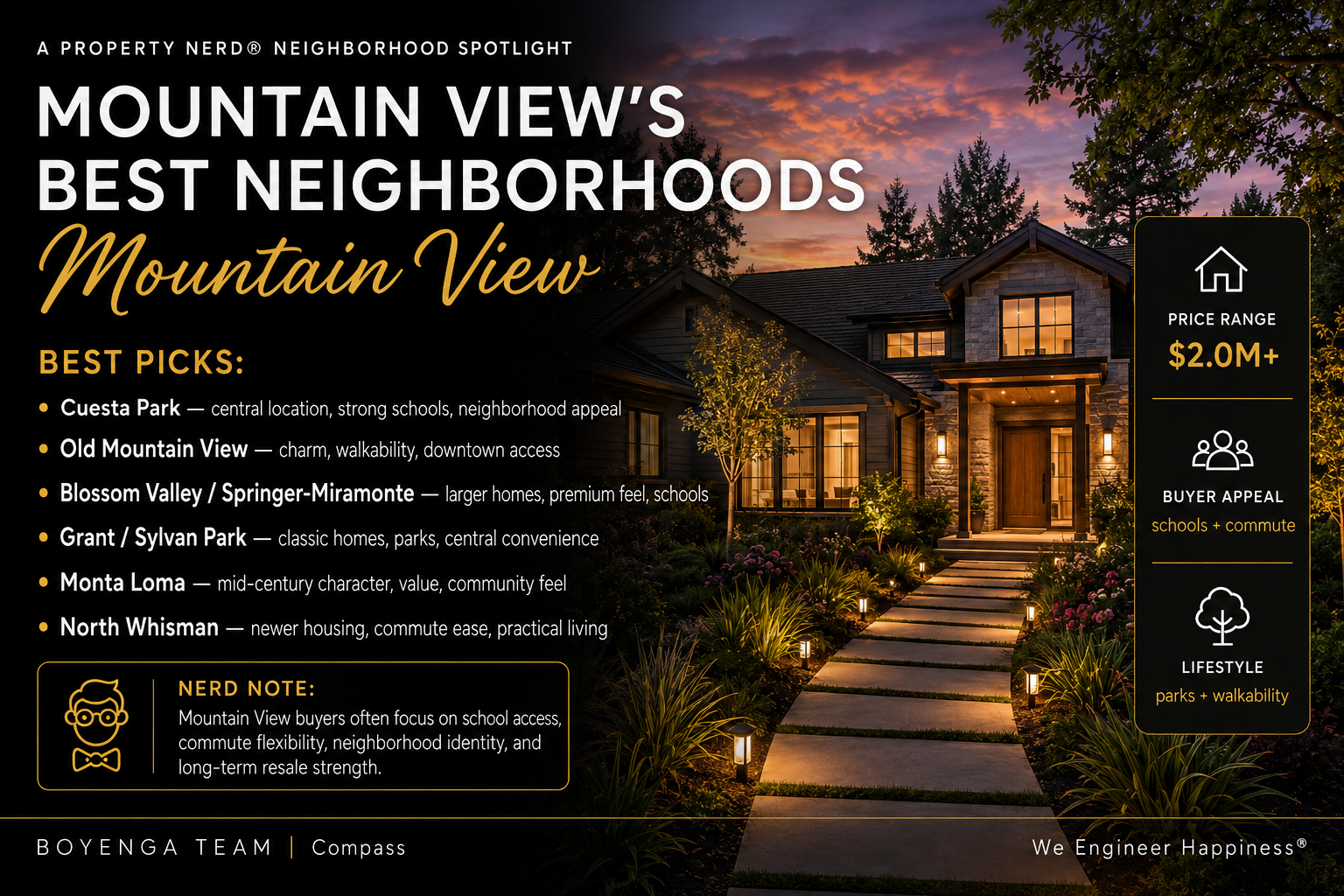
Mountain View is one of Silicon Valley’s most desirable real estate markets because it offers something rare: a true mix of tech access, downtown lifestyle, classic residential neighborhoods, mid-century architecture, Caltrain convenience, strong parks, and proximity to some of the world’s most important companies.
But Mountain View is not one simple market.
A buyer looking at Mountain View may be comparing a luxury home in Waverly Park, a family-friendly ranch in Cuesta Park, a bungalow near Castro Street in Old Mountain View, an Eichler in Monta Loma, a townhome near Whisman Station, a condo near San Antonio, or a downtown-adjacent property in Shoreline West.
All of those homes can be “Mountain View,” but they are not the same buyer story.
Mountain View is a micro-neighborhood market shaped by commute patterns, school assignments, architecture, housing type, lot size, walkability, park access, and proximity to employers like Google, Intuit, LinkedIn, NASA Ames, and the broader North Bayshore tech corridor.
The smartest way to understand Mountain View is not to ask, “What is the best neighborhood?”
The better question is:
What job does this neighborhood do for the buyer?
Does it deliver luxury? Walkability? Schools? Google commute access? Mid-century design? Downtown energy? Larger lots? Lower-maintenance townhomes? A family-friendly park setting? A more affordable entry point into Mountain View?
Once you look at Mountain View through that lens, the neighborhood map starts to make a lot more sense.
Why Mountain View Real Estate Is So Neighborhood-Sensitive
Mountain View real estate is driven by several forces at once: proximity to major tech employers, access to downtown, school boundaries, Caltrain, Highway 101, Highway 85, El Camino Real, Central Expressway, and the city’s mix of older homes, Eichlers, townhomes, condos, and newer infill development.
Unlike some cities that are dominated by one main buyer profile, Mountain View has multiple buyer pools.
Some buyers want the prestige and quiet residential feel of Waverly Park.
Some want the park access and family feel of Cuesta Park.
Some want the walkability and character of Old Mountain View.
Some want the Eichler and mid-century architecture of Monta Loma.
Some want Shoreline West because it gives them downtown access with a slightly different value profile.
Some want Whisman Station or North Whisman because the commute story is so strong.
Some want San Antonio because it connects them to Mountain View, Palo Alto, Los Altos, Caltrain, shopping, and restaurants.
That variety is what makes Mountain View such a durable market. It serves multiple Silicon Valley lifestyles at once.
1. Waverly Park
Best for: luxury buyers, larger homes, quiet streets, long-term resale strength
Waverly Park is one of Mountain View’s premier residential neighborhoods. It is often the neighborhood buyers think of when they want a more upscale, quiet, suburban feel within Mountain View.
The area is known for larger homes, wider streets in many pockets, mature landscaping, and a more established residential environment. Buyers who are considering Waverly Park may also be comparing Los Altos, Palo Alto, or higher-end pockets of Sunnyvale and Cupertino.
Waverly Park is a strong fit for buyers who want space, privacy, a neighborhood feel, and long-term resale confidence. It is less about downtown walkability and more about residential quality.
Housing can include older ranch-style homes, expanded properties, newer custom homes, and luxury remodels. Because the neighborhood carries a premium, buyers should look carefully at lot size, layout, street quality, condition, and whether the home’s improvements justify the price.
The Property Nerd read: Waverly Park is Mountain View’s confidence neighborhood. The best homes here combine a strong lot, quiet setting, good scale, and a polished residential feel.
2. Cuesta Park
Best for: family buyers, parks, schools, classic Mountain View living
Cuesta Park is one of Mountain View’s most beloved family neighborhoods. It offers access to Cuesta Park, the YMCA, residential streets, nearby shopping, and relatively easy access to both downtown Mountain View and Los Altos.
This is the kind of neighborhood that works because daily life works. Buyers like the park access, the established feel, the single-family housing stock, and the central location.
Homes are often ranch-style, remodeled ranches, or expanded single-family properties. Some homes are turnkey, while others are excellent remodel candidates. Buyers should evaluate floor plan, natural light, yard usability, garage placement, and whether the home has enough scale for the neighborhood’s price point.
Cuesta Park is especially attractive to buyers who want a real neighborhood setting without feeling too far from downtown or commute corridors.
The Property Nerd read: Cuesta Park is one of Mountain View’s best “daily life” neighborhoods. It has broad buyer appeal because it blends parks, location, family demand, and classic single-family streets.
3. Old Mountain View
Best for: downtown lifestyle, walkability, charm, Caltrain access
Old Mountain View is the neighborhood for buyers who want Mountain View with personality. It offers older homes, bungalows, cottages, condos, townhomes, apartments, and infill properties near Castro Street, Caltrain, restaurants, cafes, shops, and downtown energy.
This is one of Mountain View’s most lifestyle-driven neighborhoods. Buyers choose Old Mountain View because they want to walk to dinner, grab coffee, take Caltrain, enjoy the farmers market, and feel connected to the city’s historic core.
The housing stock can vary dramatically. Some properties are charming older homes with character. Others are newer townhomes or condos. Some single-family homes may need substantial upgrades.
Buyers should pay attention to parking, road exposure, lot size, condition, foundation, electrical, plumbing, drainage, roof, and whether additions were done properly. Walkability is valuable, but older homes require careful diligence.
The Property Nerd read: Old Mountain View wins on identity and lifestyle. It is not always the biggest-home neighborhood, but it has a strong sense of place and a durable buyer pool.
4. Blossom Valley / Springer-Miramonte
Best for: school-focused buyers, Los Altos adjacency, residential feel
The Blossom Valley / Springer-Miramonte area is one of Mountain View’s strongest family-oriented pockets, especially for buyers who care about school assignments, Los Altos proximity, and a quieter residential environment.
This part of Mountain View often attracts buyers who are comparing Mountain View with Los Altos, Sunnyvale, and Cupertino. The appeal is a combination of neighborhood feel, commute access, school demand, and proximity to parks and everyday amenities.
Homes are typically single-family properties, often ranch-style or remodeled homes, with varying lot sizes and conditions. Buyers should verify school assignment by exact address, because boundaries matter and can influence buyer demand significantly.
The Property Nerd read: Blossom Valley / Springer-Miramonte is a school-and-neighborhood play. It performs best when the home has a strong street, usable lot, good layout, and a clean school story.
5. Grant / Sylvan Park
Best for: quiet family living, parks, central access, larger-home potential
Grant / Sylvan Park is a strong residential area for buyers who want a quieter, more suburban Mountain View lifestyle. The neighborhood offers access to Sylvan Park, shopping, commute routes, and south Mountain View conveniences.
This area appeals to buyers who want a traditional single-family neighborhood rather than downtown energy or townhome density. It can be a good fit for families, move-up buyers, and people who want a calmer residential setting.
Homes vary from original ranch-style properties to remodeled and expanded homes. Buyers should compare condition, floor plan, lot usability, and street quality. In neighborhoods like this, a well-designed remodel can make a major difference in buyer response.
The Property Nerd read: Grant / Sylvan Park is a practical family neighborhood with strong livability. It may not be as flashy as Waverly Park or Old Mountain View, but it checks the boxes many buyers actually care about.
6. Shoreline West
Best for: downtown access, walkability, Stevens Creek Trail, value relative to Old Mountain View
Shoreline West is one of Mountain View’s most useful downtown-adjacent neighborhoods. It offers access to Castro Street, the Stevens Creek Trail, Caltrain, parks, restaurants, and central Mountain View amenities, often with a slightly different value profile than the most premium Old Mountain View blocks.
Buyers like Shoreline West because it gives them lifestyle access without necessarily feeling as central or expensive as Old Mountain View. It can work for single-family buyers, townhome buyers, condo buyers, and people who want a balance of walkability and residential feel.
Housing types vary, so buyers need to compare properties carefully. A single-family home, townhome, and condo in Shoreline West may appeal to different buyer pools even if they are close together on the map.
The Property Nerd read: Shoreline West is a lifestyle-value bridge. It gives buyers downtown access, trail access, and Mountain View convenience with a more flexible housing mix.
7. Monta Loma
Best for: Eichler buyers, mid-century modern design, Google/Palo Alto access
Monta Loma is one of Mountain View’s most architecturally interesting neighborhoods. It is known for its mid-century modern homes and Eichler presence, giving it a design identity that stands apart from many other Mountain View neighborhoods.
For the right buyer, Monta Loma is not just a location. It is a design lifestyle. Eichler and mid-century buyers often care about atriums, post-and-beam construction, walls of glass, radiant heat, roof systems, original paneling, indoor-outdoor flow, and architectural integrity.
Monta Loma also has a strong commute story. It sits near Palo Alto, Google, North Bayshore, San Antonio, and major commute routes. That makes it attractive to both design-focused buyers and tech commuters.
The trade-off is that Eichlers and mid-century homes require specialized diligence. Buyers should evaluate roof systems, radiant heat, slab foundation, drainage, glass exposure, electrical, insulation, and whether updates have preserved or damaged the architecture.
The Property Nerd read: Monta Loma is Mountain View’s design-nerd neighborhood. When the architecture, condition, and location line up, the buyer pool can be extremely passionate.
8. St. Francis Acres
Best for: Los Altos border, quiet streets, smaller neighborhood feel
St. Francis Acres is a smaller residential pocket near the Los Altos side of Mountain View. It appeals to buyers who want a quiet neighborhood feel, access to nearby amenities, and a location that connects well to Los Altos, El Camino Real, and central Mountain View.
This neighborhood can be attractive for buyers who want something established and residential without necessarily chasing the biggest-name neighborhoods. It may not be as widely known as Waverly Park or Cuesta Park, but it can offer strong livability.
Homes are generally single-family properties, and the key value factors are lot size, condition, street quality, and proximity to nearby corridors.
The Property Nerd read: St. Francis Acres is a quieter, more local pocket. It can be a strong fit for buyers who care more about block quality and location than neighborhood branding.
9. Rex Manor
Best for: relative value, North Bayshore access, Palo Alto proximity, practical buyers
Rex Manor is one of Mountain View’s more practical neighborhoods for buyers who want access to Palo Alto, North Bayshore, San Antonio, Costco, Google routes, and major commute corridors.
This area can offer relative value compared with more expensive south Mountain View neighborhoods, depending on the property and exact location. Buyers may choose Rex Manor because it makes the commute and budget math work.
Housing can vary, and buyers should look carefully at street quality, road exposure, condition, and long-term upside. This is a neighborhood where property fundamentals matter more than prestige branding.
The Property Nerd read: Rex Manor is a practical access neighborhood. It can be smart when the home has good bones, a solid street, and a price that reflects the competitive set.
10. North Whisman
Best for: tech commuters, light rail, Google access, practical convenience
North Whisman is a commute-focused Mountain View neighborhood with strong access to light rail, Central Expressway, Highway 237, Highway 101, Google, LinkedIn, NASA Ames, and the broader North Bayshore employment base.
This area can appeal to buyers who prioritize convenience and tech access more than traditional single-family neighborhood prestige. It includes a mix of housing types, including single-family homes, townhomes, condos, and apartments depending on the exact location.
North Whisman is especially relevant for buyers who want to reduce commute friction. It may not have the same charm as Old Mountain View or the luxury feel of Waverly Park, but it has a very clear function.
The Property Nerd read: North Whisman is a commute-geometry play. It is strongest for buyers who want Mountain View access and proximity to major employers.
11. Whisman Station
Best for: townhomes, light rail, lower-maintenance living, tech commute
Whisman Station is one of Mountain View’s key townhome-oriented neighborhoods. It appeals to buyers who want newer or lower-maintenance housing, access to light rail, commute convenience, and a planned-community feel.
This area is especially attractive to professionals, first-time buyers, downsizers, and tech workers who want Mountain View without taking on the maintenance or price point of a larger single-family home.
For townhome and condo buyers, HOA due diligence is essential. Buyers should evaluate HOA dues, reserves, insurance, rental restrictions, litigation, exterior maintenance responsibilities, parking, guest parking, and upcoming capital projects.
The Property Nerd read: Whisman Station is Mountain View’s practical townhome commute lane. It is not trying to be Waverly Park or Old Mountain View. It works because it solves for access and convenience.
12. The Crossings
Best for: San Antonio convenience, planned-community feel, Palo Alto/Los Altos access
The Crossings is a planned-community-style neighborhood near the San Antonio area, with excellent access to shopping, Caltrain, Palo Alto, Los Altos, and central Mountain View.
This area appeals to buyers who want convenience and a more organized community feel. It is especially useful for buyers who want to be near San Antonio shopping, transit, restaurants, and major commute routes.
Housing includes townhomes, condos, and related planned-community product. Buyers should pay attention to HOA structure, parking, layout, outdoor space, and how the property compares with other nearby townhome and condo options.
The Property Nerd read: The Crossings is a convenience-and-connectivity neighborhood. It works well for buyers who want Mountain View access with Palo Alto and Los Altos nearby.
13. San Antonio / Greater San Antonio Area
Best for: shopping, transit, condos, townhomes, Palo Alto/Los Altos access
The San Antonio / Greater San Antonio area is one of Mountain View’s most important convenience zones. It offers access to San Antonio Center, Caltrain, restaurants, shopping, apartments, condos, townhomes, and nearby single-family pockets.
This area is not always a classic single-family neighborhood in the traditional sense. It is more of a lifestyle and access district. Buyers who choose this area often want convenience, transit, and proximity to multiple cities at once: Mountain View, Palo Alto, Los Altos, and Sunnyvale.
For buyers, the key question is housing type. A condo near San Antonio competes differently from a single-family home nearby. Parking, HOA health, noise, walkability, and building quality all matter.
The Property Nerd read: San Antonio is Mountain View’s multi-city connector. It gives buyers shopping, transit, access, and flexibility.
14. Jackson Park / Downtown Adjacent
Best for: Old Mountain View convenience, central access, slightly quieter lifestyle
Jackson Park / Downtown Adjacent areas are useful for buyers who want Old Mountain View convenience but may not need to be directly in the most premium downtown blocks.
These pockets can offer access to Castro Street, parks, Caltrain, restaurants, and central Mountain View amenities while sometimes providing a slightly more residential or value-conscious alternative.
Housing types vary, including older homes, condos, townhomes, and infill development. Buyers should evaluate condition, street quality, parking, and whether the property benefits from downtown access without suffering too much from traffic or noise.
The Property Nerd read: Jackson Park / Downtown Adjacent is a downtown-adjacent strategy. It gives buyers lifestyle access with more nuance than simply saying “Old Mountain View.”
15. Moffett / Slater Area
Best for: commute access, practical value, North Bayshore proximity
The Moffett / Slater area is a practical Mountain View pocket with strong access to North Bayshore, NASA Ames, Google routes, Moffett Field, Highway 101, and downtown Mountain View.
This area may appeal to buyers who want Mountain View access and commute convenience without paying for the most premium south-side neighborhoods. It can include a mix of housing types and varying street environments.
As with many practical commute neighborhoods, exact location matters. Buyers should evaluate road exposure, noise, nearby commercial uses, and whether the home or community feels residential enough for their lifestyle.
The Property Nerd read: Moffett / Slater is a practical access play. It can make sense for buyers who want Mountain View location, tech proximity, and relative value.
How to Think About Mountain View by Buyer Type
Best for luxury and prestige
Waverly Park
Waverly Park is the clearest choice for buyers who want a larger-home, upscale, quiet residential environment in Mountain View.
Best for classic family living
Cuesta Park, Blossom Valley / Springer-Miramonte, Grant / Sylvan Park, St. Francis Acres
These areas offer residential streets, parks, single-family homes, and broad family buyer appeal.
Best for downtown walkability
Old Mountain View, Shoreline West, Jackson Park / Downtown Adjacent
These neighborhoods appeal to buyers who want restaurants, Caltrain, cafes, shopping, and a strong sense of place.
Best for Eichler and mid-century modern buyers
Monta Loma
Monta Loma is the standout Mountain View neighborhood for buyers who love Eichler homes, mid-century design, and architectural identity.
Best for Google and North Bayshore commute
Monta Loma, North Whisman, Whisman Station, Moffett / Slater, Rex Manor
These neighborhoods work well for buyers who want proximity to major tech employers and commute corridors.
Best for townhomes and lower-maintenance living
Whisman Station, The Crossings, San Antonio, Downtown-adjacent pockets
These areas are strong for buyers who want Mountain View access without the maintenance of a traditional single-family home.
Best for shopping, transit, and multi-city convenience
San Antonio / Greater San Antonio, The Crossings, Old Mountain View
These areas offer strong access to Caltrain, shopping, restaurants, and neighboring Palo Alto and Los Altos.
Mountain View Neighborhoods and Housing Types
One of the biggest mistakes buyers make in Mountain View is comparing homes without comparing property type.
A Mountain View property might be:
A luxury home in Waverly Park.
A ranch home in Cuesta Park.
A bungalow in Old Mountain View.
An Eichler in Monta Loma.
A townhome in Whisman Station.
A condo near San Antonio.
A downtown-adjacent infill property.
A practical single-family home near Rex Manor or Moffett.
These properties should not be evaluated the same way.
For single-family homes, buyers should focus on lot size, floor plan, usable yard space, orientation, expansion potential, school assignment, street quality, and remodel quality.
For older homes, buyers should evaluate foundation, electrical, plumbing, roof, sewer, drainage, termite, insulation, windows, and permit history.
For Eichlers and mid-century homes, buyers should pay special attention to roof systems, slab radiant heat, drainage, glass exposure, electrical, insulation, waterproofing, and architectural integrity.
For condos and townhomes, buyers should review HOA dues, reserves, insurance, litigation, rental restrictions, parking, storage, exterior maintenance, and upcoming capital projects.
For downtown properties, buyers should think about noise, parking, walkability, transit access, and whether the property balances lifestyle with livability.
The Property Nerd Bottom Line
Mountain View is one of Silicon Valley’s most strategic real estate cities because it offers many different ways to win.
Waverly Park delivers luxury, space, and prestige. Cuesta Park offers classic family living and park access. Old Mountain View provides downtown charm and walkability. Blossom Valley / Springer-Miramonte and Grant / Sylvan Park appeal to family buyers who want residential streets and long-term resale strength. Shoreline West gives buyers a downtown-adjacent lifestyle with flexibility. Monta Loma attracts Eichler and mid-century modern fans. Rex Manor, North Whisman, Whisman Station, and Moffett / Slater serve practical tech commuters. The Crossings and San Antonio offer shopping, transit, and multi-city convenience.
The smartest Mountain View buyers do not just ask, “Is this a good neighborhood?”
They ask:
What buyer pool will want this home when I sell?
Is the value driven by walkability, commute, schools, architecture, lot size, or lifestyle?
Is the street quiet enough?
Is the lot usable?
Is the floor plan fixable?
Is this home priced for its condition?
Does the neighborhood support the future value of the property?
Is this a luxury purchase, a school purchase, an architecture purchase, a commute purchase, a downtown lifestyle purchase, or a value purchase?
That is how you understand Mountain View.
For sellers, the lesson is just as important. A Waverly Park home should not be marketed the same way as a Monta Loma Eichler. A Cuesta Park ranch needs a different story than an Old Mountain View bungalow. A Whisman Station townhome needs different positioning than a Shoreline West single-family home. A San Antonio condo should not be treated like a Grant / Sylvan Park family home.
In Mountain View, the neighborhood story matters. The commute matters. The architecture matters. The school assignment matters. The lot matters. The street matters. The future buyer pool matters.
That is why Mountain View remains one of Silicon Valley’s most durable and high-demand real estate markets — not because every neighborhood is the same, but because each one gives buyers a different way to plug into the Silicon Valley lifestyle.