

Blog > Best Menlo Park Neighborhoods: A Property Nerds Guide to Where to Live in Menlo Park, CA
Best Menlo Park Neighborhoods: A Property Nerds Guide to Where to Live in Menlo Park, CA
by
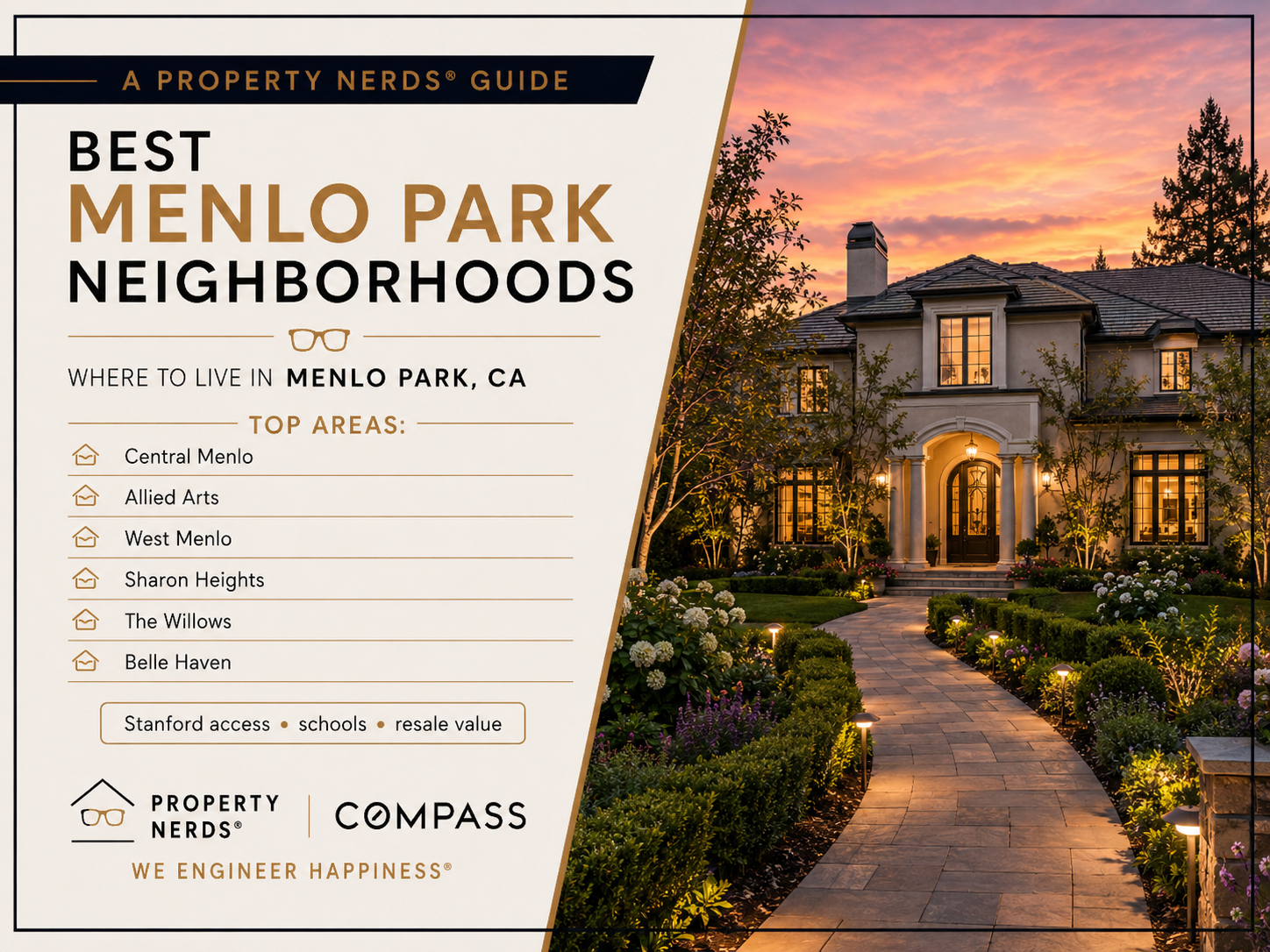
Menlo Park is one of Silicon Valley’s most strategic and quietly prestigious real estate markets. It sits at the intersection of Stanford, Palo Alto, Atherton, Redwood City, Sand Hill Road, Meta, venture capital, excellent schools, leafy residential streets, and some of the most valuable real estate on the Peninsula.
But Menlo Park is not one simple market.
A buyer looking at Menlo Park may be comparing a charming cottage in Allied Arts, a luxury home in Central Menlo, a family property in West Menlo, a townhome near downtown, a hillside home in Sharon Heights, a practical single-family home in The Willows, a Stanford-adjacent property near University Heights, or an emerging opportunity in Belle Haven.
All of those homes can be “Menlo Park,” but they are not the same buyer story.
Menlo Park is a micro-neighborhood market shaped by school assignment, proximity to downtown Menlo Park, Stanford access, commute direction, lot size, architectural quality, flood zone considerations, remodel potential, neighborhood identity, and the future buyer pool.
That is why the Property Nerds of the Boyenga Team study Menlo Park neighborhood by neighborhood, block by block, and buyer pool by buyer pool. In Menlo Park, value is not just about square footage or zip code. It is about the neighborhood story, the street, the lot, the home’s era, the school path, the commute pattern, and how future buyers will emotionally respond to the property.
The smartest way to understand Menlo Park is not to ask, “What is the best neighborhood?”
The better question is:
What job does this neighborhood do for the buyer?
Does it deliver prestige? walkability? top schools? Stanford access? Sand Hill Road proximity? Atherton adjacency? Meta commute convenience? remodel upside? luxury privacy? downtown lifestyle? a quieter family setting? long-term resale strength?
Once you look at Menlo Park through that lens, the neighborhood map becomes much clearer.
Why Menlo Park Real Estate Is So Neighborhood-Sensitive
Menlo Park real estate is one of the most nuanced markets on the Peninsula because the city serves multiple high-value buyer pools.
Some buyers want Central Menlo because it offers prestige, schools, and access to downtown Menlo Park.
Some want Allied Arts because of charm, walkability, and proximity to Stanford Shopping Center, Palo Alto, and downtown Menlo Park.
Some want West Menlo because of family lifestyle, top schools, and access to Sharon Park, Stanford, Sand Hill Road, and Highway 280.
Some want Sharon Heights because of hillside privacy, views, larger homes, and a quieter luxury setting.
Some want Linfield Oaks because it offers downtown access, Caltrain proximity, and a more central lifestyle.
Some want The Willows because it has character, Palo Alto access, and relative value compared with nearby Palo Alto neighborhoods.
Some want Belle Haven because of Meta proximity, newer development energy, and a more value-oriented entry into Menlo Park.
That variety is what makes Menlo Park so powerful. It serves luxury buyers, Stanford buyers, venture capital buyers, family buyers, tech commuters, downsizers, investors, and value-focused Peninsula buyers — but each neighborhood tells a very different story.
1. Central Menlo
Best for: prestige, top schools, downtown access, long-term resale strength
Central Menlo is one of Menlo Park’s most desirable and recognized residential neighborhoods. It sits close to downtown Menlo Park, excellent schools, parks, Stanford, Palo Alto, Sand Hill Road, and Atherton. This is the neighborhood many buyers picture when they think of classic Menlo Park living.
The appeal is broad and deep. Central Menlo offers tree-lined streets, single-family homes, strong school demand, proximity to shopping and restaurants, and a sense of established Peninsula prestige.
Homes can range from older cottages and ranch-style properties to significant custom builds and luxury remodels. Because buyer demand is strong, property-level details matter tremendously. Lot size, floor plan, natural light, privacy, garage placement, street quality, and remodel quality all affect value.
For sellers, Central Menlo homes should not be marketed generically. Buyers need to understand the lifestyle: downtown access, school appeal, Stanford proximity, Sand Hill Road convenience, and the long-term scarcity of well-located Menlo Park single-family homes.
The Property Nerds read: Central Menlo is one of Menlo Park’s confidence neighborhoods. The best homes combine a quiet street, strong lot, modernized floor plan, and a polished neighborhood story.
2. Allied Arts
Best for: charm, walkability, Stanford/Palo Alto access, boutique neighborhood feel
Allied Arts is one of Menlo Park’s most charming and emotionally appealing neighborhoods. It offers tree-lined streets, smaller-scale homes, character properties, and proximity to downtown Menlo Park, Stanford Shopping Center, Palo Alto, Stanford University, and Caltrain.
This is the neighborhood for buyers who want Menlo Park with charm and lifestyle. Allied Arts buyers often value walkability, architectural personality, mature landscaping, and a more intimate neighborhood feel.
Homes can include cottages, bungalows, older single-family properties, remodeled homes, and newer builds on smaller lots. The trade-off is that homes may be smaller or older than in other premium Menlo Park neighborhoods, but the location and charm can be extremely powerful.
Buyers should evaluate foundation, electrical, plumbing, roof, drainage, sewer, permits, parking, and whether additions or remodels were done thoughtfully.
The Property Nerds read: Allied Arts wins on charm and scarcity. A well-prepared home here can attract buyers who care as much about lifestyle and location as they do about square footage.
3. West Menlo Park
Best for: schools, family buyers, Stanford access, Sharon Heights / Sand Hill convenience
West Menlo Park is one of the strongest family-oriented areas in the Menlo Park orbit. It offers access to highly sought-after schools, residential streets, parks, Stanford, Sand Hill Road, Highway 280, and nearby Sharon Heights amenities.
This area appeals to buyers who want a suburban family setting with excellent Peninsula connectivity. They may be comparing Menlo Park with Palo Alto, Los Altos, Portola Valley, Atherton, or Redwood City, depending on budget and school priorities.
Homes are often single-family properties, including ranch homes, remodels, and custom rebuilds. Buyers should pay attention to lot size, floor plan, yard usability, street quality, and school assignment by exact address.
The Property Nerds read: West Menlo Park is a school-and-family powerhouse. The strongest homes offer quiet streets, functional lots, good light, updated systems, and strong resale fundamentals.
4. Sharon Heights
Best for: privacy, larger homes, hillside setting, luxury buyers, golf and open space access
Sharon Heights offers a different version of Menlo Park: quieter, more private, more hillside-oriented, and often more luxury-focused. Buyers are drawn to larger homes, views, mature trees, Sharon Heights Golf & Country Club proximity, nearby shopping, and access to Highway 280 and Sand Hill Road.
This area appeals to buyers who want Menlo Park prestige but prefer more space and privacy than they might find closer to downtown.
Homes can include larger custom properties, townhomes, condos, and single-family residences depending on the exact location. Some properties offer views or a more secluded setting, while others are in planned communities or HOA-managed environments.
Buyers should evaluate slope, drainage, retaining walls, foundation systems, HOA details if applicable, driveway usability, tree maintenance, insurance, and long-term maintenance.
The Property Nerds read: Sharon Heights is Menlo Park’s privacy-and-hillside lane. It works best when the property offers strong function, good access, and a compelling setting.
5. Linfield Oaks
Best for: downtown access, Caltrain, central convenience, tree-lined streets
Linfield Oaks is a centrally located Menlo Park neighborhood with strong lifestyle appeal. Buyers like the proximity to downtown Menlo Park, Caltrain, Burgess Park, schools, Stanford, Palo Alto, and major commute routes.
This area can be especially appealing for buyers who want walkability and convenience without necessarily being in the most premium Central Menlo blocks.
Homes can vary from older single-family properties to updated homes and rebuilt residences. Buyers should evaluate parking, street quality, road or train proximity, lot size, condition, and whether the home has a strong owner-occupant resale story.
The Property Nerds read: Linfield Oaks is a convenience-and-lifestyle neighborhood. The best homes balance central access with quiet residential livability.
6. The Willows
Best for: Palo Alto access, character homes, relative value, creative buyer pool
The Willows is one of Menlo Park’s most interesting and character-rich neighborhoods. It sits near Palo Alto, East Palo Alto, University Avenue access routes, and major commute corridors. Buyers often like the neighborhood’s older homes, eclectic feel, tree-lined streets, and proximity to both Menlo Park and Palo Alto.
The Willows can appeal to buyers who want charm and access but may be priced out of Palo Alto or Central Menlo. It has a more relaxed and organic feel than some of Menlo Park’s more polished luxury areas.
Homes can include older cottages, bungalows, ranch homes, remodels, and rebuilds. Buyers should be careful with flood considerations, road exposure, foundation, drainage, sewer, permits, and neighborhood-by-block variation.
The Property Nerds read: The Willows is a character-and-access neighborhood. It can be a smart fit for buyers who want Peninsula convenience, charm, and relative value — but the exact block matters.
7. Suburban Park / Lorelei Manor / Flood Triangle
Best for: family buyers, relative value, Redwood City/Atherton access, practical living
Suburban Park, Lorelei Manor, and nearby Flood Triangle pockets offer a more practical and value-conscious Menlo Park experience compared with Central Menlo, Allied Arts, or West Menlo.
These neighborhoods are attractive to buyers who want single-family homes, access to Menlo Park and Redwood City, proximity to Atherton, and a more approachable entry point into the Menlo Park area.
Homes are often mid-century ranch-style properties, some original and some updated. Buyers should evaluate school assignment, street quality, flood zone considerations, lot utility, condition, and how future buyers will compare the home with Redwood City, Menlo Park, or Atherton-adjacent alternatives.
The Property Nerds read: Suburban Park / Lorelei Manor / Flood Triangle is a practical Peninsula value pocket. It works best when the home is well-positioned, well-maintained, and priced against the correct buyer pool.
8. Felton Gables
Best for: privacy, charm, creekside setting, boutique luxury
Felton Gables is one of Menlo Park’s most distinctive small neighborhoods. It has a quiet, almost hidden quality, with mature trees, creekside character, and a boutique residential feel near Menlo Park, Atherton, and Redwood City.
This area appeals to buyers who want something private, charming, and less obvious than the larger-name neighborhoods. It can feel special because of its scale and atmosphere.
Homes vary, but the strongest properties offer privacy, architectural appeal, and a strong relationship to the natural setting. Buyers should evaluate creek proximity, flood risk, drainage, foundation, tree maintenance, road access, and insurance considerations.
The Property Nerds read: Felton Gables is a hidden-gem luxury pocket. It can be incredibly compelling for buyers who value privacy, charm, and a quieter Peninsula lifestyle.
9. University Heights / Stanford Hills Area
Best for: Stanford access, views, privacy, academic and executive buyers
University Heights and Stanford Hills-adjacent areas offer a unique Menlo Park profile with access to Stanford, Sand Hill Road, Highway 280, and nearby open space. Buyers may be drawn to privacy, views, larger lots, and proximity to the Stanford ecosystem.
This area can appeal to Stanford-affiliated buyers, venture capital professionals, tech executives, and buyers looking for a quieter hillside setting with excellent Peninsula access.
Homes may have more complex lot conditions than flatter neighborhoods. Buyers should evaluate slope, drainage, retaining walls, foundation systems, driveway access, fire insurance, tree maintenance, and utility infrastructure.
The Property Nerds read: University Heights / Stanford Hills is a privacy-and-proximity pocket. It is strongest when the home combines Stanford access with a usable, well-maintained property.
10. Downtown Menlo Park
Best for: walkability, restaurants, Caltrain, condos, townhomes, lifestyle buyers
Downtown Menlo Park is ideal for buyers who want restaurants, coffee, shops, Caltrain, parks, and a walkable lifestyle. This area is especially appealing to downsizers, professionals, Stanford-affiliated buyers, and people who want less maintenance and more convenience.
Housing can include condos, townhomes, apartments, and nearby single-family homes. The key is understanding the property type. A downtown condo competes differently than a Central Menlo single-family home.
For condo and townhome buyers, HOA diligence matters. Buyers should evaluate dues, reserves, insurance, litigation, rental restrictions, parking, storage, exterior maintenance, and upcoming capital projects.
The Property Nerds read: Downtown Menlo Park is a lifestyle-and-access lane. It works best for buyers who want walkability and convenience more than a large yard.
11. Belle Haven
Best for: Meta commute, value, newer development energy, East Menlo Park access
Belle Haven is one of Menlo Park’s most talked-about neighborhoods because it sits near Meta, the Bayfront, Highway 101, and major employment centers. It offers a very different value profile than west-side Menlo Park neighborhoods.
Buyers may be drawn to Belle Haven for commute convenience, relative value, investment potential, and newer development energy. It can appeal to tech workers, first-time buyers, investors, and buyers who want a more attainable path into Menlo Park.
The trade-offs are important. Buyers should evaluate flood considerations, neighborhood perception, traffic, school assignment, environmental factors, road exposure, and long-term resale demand.
The Property Nerds read: Belle Haven is a value-and-growth neighborhood. It can be smart for the right buyer, but it needs careful analysis of risk, upside, and future buyer perception.
12. Menlo Oaks
Best for: larger lots, estate feel, privacy, Atherton/Palo Alto adjacency
Menlo Oaks is one of the most distinctive and desirable Menlo Park-area pockets, known for larger lots, mature oaks, a quiet residential feel, and proximity to Atherton and Palo Alto.
This area can appeal to buyers looking for privacy, estate-like settings, and a less formal but highly desirable residential environment. Some buyers may compare Menlo Oaks with Atherton, West Menlo, and Palo Alto edge neighborhoods.
Homes can range from older ranch-style properties to custom estates and major rebuilds. Lot quality is especially important. Buyers should evaluate tree impacts, privacy, usable yard space, drainage, foundation, and whether the home’s scale matches the land.
The Property Nerds read: Menlo Oaks is a land-and-privacy neighborhood. The best properties offer a rare combination of space, trees, calm, and Peninsula access.
13. Vintage Oaks / Park Forest Area
Best for: family buyers, parks, central-west access, strong residential feel
Vintage Oaks and Park Forest offer a strong residential setting with family appeal, parks, and convenient access to west Menlo Park, Sharon Heights, Sand Hill Road, and Highway 280.
These neighborhoods can be appealing for buyers who want a quieter family environment without being as hillside-oriented as Sharon Heights or as central as downtown Menlo Park.
Homes are often single-family properties with varying ages and remodel levels. Buyers should evaluate school assignment, lot utility, floor plan, street quality, and condition.
The Property Nerds read: Vintage Oaks / Park Forest is a practical family-resale pocket. It works when the home offers a strong neighborhood feel and clean daily-life function.
14. Stanford Weekend Acres / West Menlo Edge
Best for: quiet residential setting, Stanford proximity, larger lots in some pockets
Stanford Weekend Acres and west Menlo edge pockets can appeal to buyers who want a quieter residential environment near Stanford, Sand Hill Road, Sharon Heights, and Highway 280.
This area may attract buyers who prioritize privacy, school assignment, and commute access to Stanford, venture capital firms, and West Peninsula employers.
Homes vary, and buyers should evaluate lot size, street quality, topography, drainage, and whether the home has a strong long-term resale story.
The Property Nerds read: Stanford Weekend Acres / West Menlo Edge is a quiet-proximity neighborhood. The best properties combine calm residential living with powerful regional access.
15. Menlo Park / Atherton Border
Best for: prestige adjacency, larger homes, resale strength, luxury buyer pool
The Menlo Park / Atherton border is a highly strategic area because it can benefit from proximity to one of the most prestigious residential markets in the country. Buyers may be drawn to Menlo Park homes that offer Atherton-adjacent privacy, larger lots, or strong location value without crossing fully into Atherton pricing.
The exact street matters tremendously. A home near Atherton may feel highly prestigious, but value still depends on lot quality, condition, school assignment, privacy, and buyer perception.
The Property Nerds read: Menlo Park / Atherton border properties are all about adjacency and execution. The right home can capture luxury buyer attention, but the property must justify the premium.
How to Think About Menlo Park by Buyer Type
Best for prestige and resale strength
Central Menlo, Allied Arts, West Menlo Park, Menlo Oaks, Menlo Park / Atherton border
These neighborhoods attract deep buyer pools because they combine location, schools, privacy, and long-term Peninsula demand.
Best for walkability
Allied Arts, Downtown Menlo Park, Linfield Oaks, Central Menlo, College Avenue / Stanford-adjacent pockets
These areas are ideal for buyers who want restaurants, Caltrain, shops, Stanford access, and a more connected daily routine.
Best for family living
West Menlo Park, Central Menlo, Vintage Oaks, Park Forest, Suburban Park, Menlo Oaks
These areas offer residential streets, schools, parks, and practical long-term livability.
Best for luxury and privacy
Sharon Heights, Menlo Oaks, Felton Gables, University Heights / Stanford Hills, Atherton-border pockets
These neighborhoods appeal to buyers who want larger homes, privacy, setting, and a more exclusive residential experience.
Best for Stanford and Sand Hill Road access
Allied Arts, Central Menlo, West Menlo Park, University Heights, Stanford Weekend Acres, Sharon Heights
These areas are strong for Stanford-affiliated buyers, venture capital professionals, executives, and people who want quick access to the Stanford/Sand Hill ecosystem.
Best for Meta commute and value
Belle Haven, The Willows, east-side Menlo Park pockets
These neighborhoods can appeal to buyers who prioritize Meta access, Highway 101, and relative value.
Best for relative value within Menlo Park
Belle Haven, The Willows, Suburban Park, Lorelei Manor, Flood Triangle, select condo and townhome pockets
These areas may provide more attainable entry points depending on school assignment, condition, flood risk, and future buyer perception.
Menlo Park Housing Types
One of the biggest mistakes buyers make in Menlo Park is comparing homes without considering property type, school path, and neighborhood identity.
A Menlo Park property might be:
A Central Menlo luxury rebuild.
An Allied Arts cottage.
A West Menlo family home.
A Sharon Heights hillside property.
A Downtown Menlo Park condo.
A Willows bungalow.
A Belle Haven starter home.
A Menlo Oaks estate.
A Felton Gables hidden-gem property.
Those homes should not be evaluated the same way.
For single-family homes, buyers should focus on lot size, usable yard space, floor plan, privacy, school assignment, street quality, road exposure, remodel quality, and commute access.
For older homes, buyers should evaluate foundation, electrical, plumbing, roof, drainage, sewer, termite, insulation, windows, and permit history.
For luxury homes, buyers should look beyond square footage. Architecture, privacy, ceiling height, indoor-outdoor flow, landscaping, pool condition, guest parking, gates, natural light, materials, and build quality all influence value.
For hillside homes, buyers should evaluate slope, drainage, retaining walls, foundation systems, driveway access, tree maintenance, fire risk, insurance, and long-term upkeep.
For condos and townhomes, buyers should review HOA dues, reserves, insurance, litigation, rental restrictions, parking, guest parking, storage, exterior maintenance responsibilities, and upcoming capital projects.
For flood-influenced or creek-adjacent properties, buyers should review flood maps, insurance requirements, drainage, foundation, soil conditions, and long-term maintenance.
For East Menlo Park and Bay-adjacent properties, buyers should evaluate flood risk, environmental context, commute access, neighborhood perception, and long-term redevelopment patterns.
The Property Nerds Bottom Line
Menlo Park is one of Silicon Valley’s most strategic real estate markets because it offers many different ways to win.
Central Menlo delivers prestige, schools, downtown access, and long-term resale strength. Allied Arts offers charm, walkability, and Stanford/Palo Alto convenience. West Menlo Park brings family living, schools, and Sand Hill Road access. Sharon Heights offers privacy, hillside setting, and luxury appeal. Linfield Oaks provides central convenience and Caltrain access. The Willows brings character, Palo Alto proximity, and relative value. Suburban Park, Lorelei Manor, and Flood Triangle create practical entry points into the Menlo Park area. Felton Gables offers boutique privacy and charm. University Heights and Stanford Hills pockets serve buyers who want Stanford access and a quieter setting. Belle Haven brings Meta proximity, value, and growth potential. Menlo Oaks and Atherton-border areas create larger-lot and prestige-adjacent opportunities.
The smartest Menlo Park buyers do not just ask, “Is this a good neighborhood?”
They ask:
What buyer pool will want this home when I sell?
Is the value driven by schools, Stanford access, Sand Hill Road, Meta commute, walkability, privacy, lot size, or relative affordability?
Is the street quiet enough?
Is the lot usable?
Is the floor plan fixable?
Is the home priced for its condition?
Are there flood, creek, tree, slope, or permit issues?
Does the neighborhood support future value?
Is this a family purchase, a Stanford purchase, a VC/Sand Hill purchase, a downtown lifestyle purchase, a luxury privacy purchase, a Meta commute purchase, or a value purchase?
That is how you understand Menlo Park.
For sellers, the lesson is just as important. A Central Menlo home should not be marketed the same way as a Belle Haven property. An Allied Arts cottage needs a different story than a Sharon Heights hillside home. A Willows bungalow needs different positioning than a Menlo Oaks estate. A downtown condo should not be marketed like a West Menlo family home.
In Menlo Park, the neighborhood story matters. The school assignment matters. The commute matters. The architecture matters. The lot matters. The flood zone matters. The street matters. The future buyer pool matters.
That is why the Property Nerds of the Boyenga Team study Menlo Park at the micro-market level. We help buyers and sellers understand not just what a home is, but what it means in the market — how it competes, who will want it, what drives value, and what details could affect resale.
Thinking About Buying or Selling in Menlo Park?
The Boyenga Team at Compass helps clients decode Menlo Park real estate with a Property Nerds approach — blending neighborhood knowledge, pricing strategy, preparation advice, design insight, school and commute logic, architectural awareness, and buyer-behavior analysis.
Whether you are buying an Allied Arts cottage, selling a Central Menlo luxury home, comparing West Menlo family neighborhoods, preparing a Sharon Heights property, evaluating a Willows bungalow, or positioning a Belle Haven home near Meta, Eric and Janelle Boyenga can help you understand the neighborhood math before you make your move.
Menlo Park is not one market. It is a city of micro-markets. And the right strategy starts with knowing which one you are really in.