
Blog > Before the Listing Agreement: Twelve Decisions Silicon Valley Trustees and Beneficiaries Should Make
Before the Listing Agreement: Twelve Decisions Silicon Valley Trustees and Beneficiaries Should Make
by
Before the Listing Agreement: Twelve Decisions Silicon Valley Trustees and Beneficiaries Should Make
A Property Nerds Guide to Aligning Expectations Before Bringing a Home to Market
Signing a listing agreement often feels like the beginning of a home sale. In reality, it's usually much closer to the end of the planning process.
By the time a Silicon Valley home is ready to be listed, trustees and beneficiaries have already made dozens of decisions—some consciously, others by default. They've discussed whether to sell immediately or wait, whether to renovate or simply refresh, how aggressively to price the property, and what success ultimately looks like. Those conversations shape nearly every outcome that follows.
As Property Nerds, we've learned that the strongest sales rarely happen because of one brilliant marketing campaign or negotiation strategy. They happen because everyone involved spent time making the right decisions before the property ever reached the MLS.
The Listing Agreement Is a Milestone—Not the Starting Line
Many trustees assume that hiring a real estate professional is the first major decision they'll make. In reality, it's one of the last.
Before selecting an agent, families benefit from understanding the property's condition, gathering trust documentation, discussing beneficiary expectations, reviewing tax and legal considerations with advisors, and establishing realistic objectives for the sale.
The clearer those conversations are upfront, the smoother the entire process becomes.
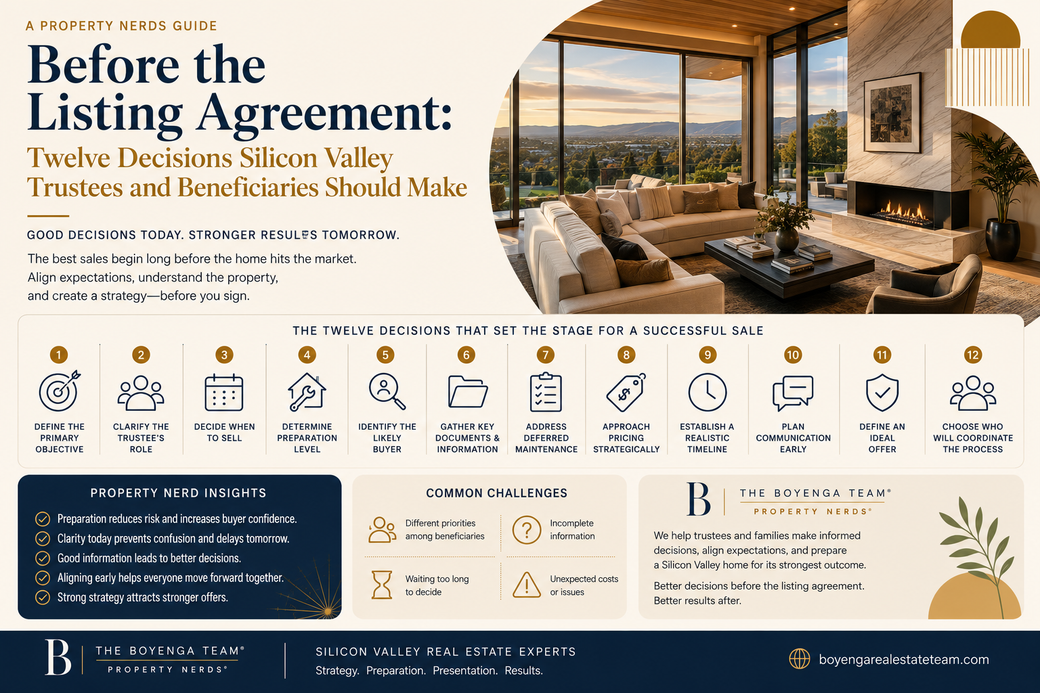
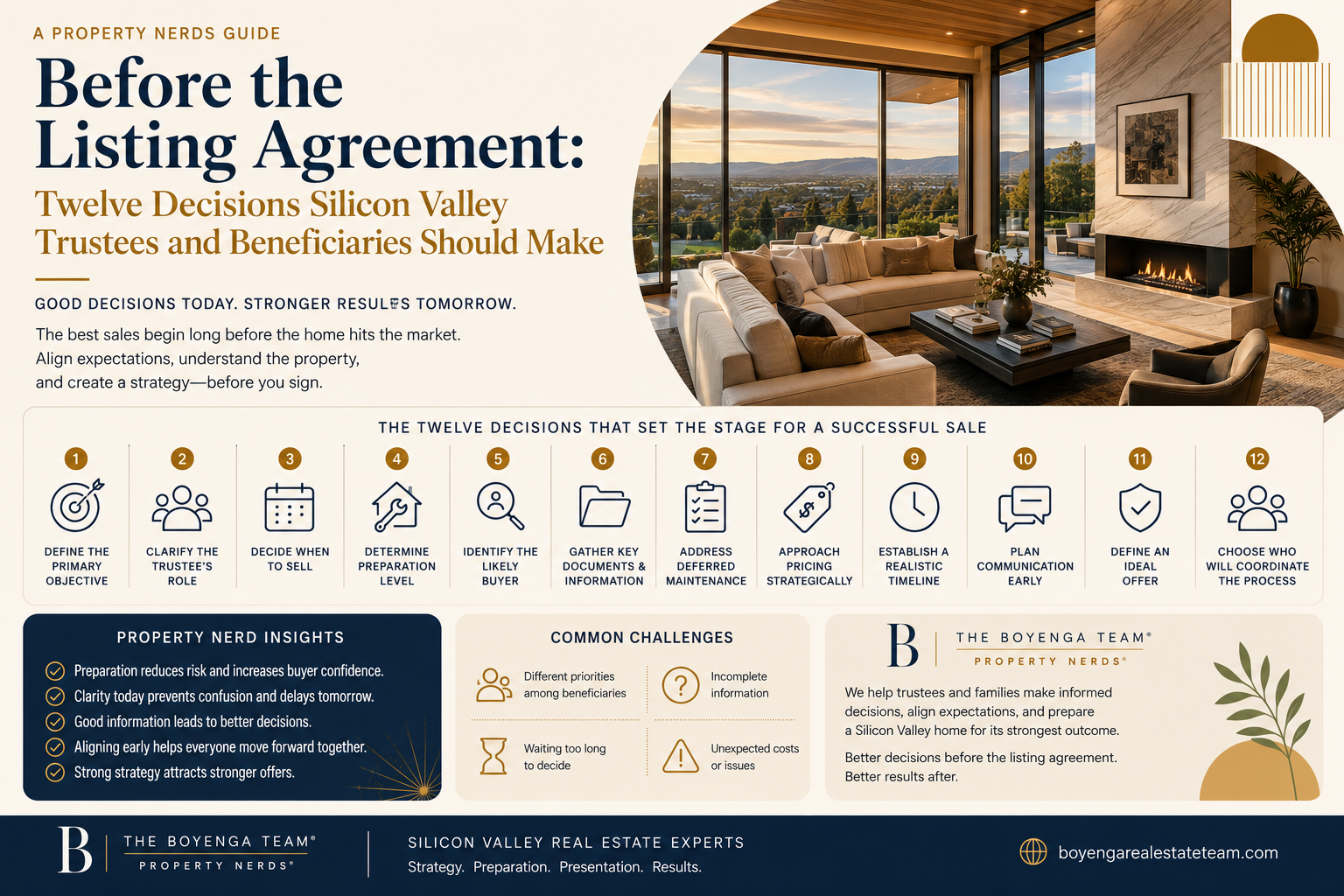
Twelve Decisions Worth Making Before Listing
Every trust sale is different, but we've found these conversations consistently help trustees move forward with greater confidence.
1. What is the primary objective?
Is the goal to maximize sale price, minimize stress, close quickly, or preserve the home's legacy? Success should be defined before strategy is developed.
2. Does everyone understand the trustee's role?
Beneficiaries often provide valuable input, but trustees have legal responsibilities that extend beyond family preferences. Clarifying roles early reduces future misunderstandings.
3. Should the property be sold now—or later?
Market conditions, occupancy, tax considerations, and family timing may all influence when selling makes the most sense.
4. How much preparation is appropriate?
Not every home benefits from a major renovation. Some properties need strategic updates, while others are best marketed as opportunities for future improvement.
5. Who is the most likely buyer?
A luxury estate, original ranch home, and architecturally significant property each attract different buyer pools. Understanding the audience influences every preparation and marketing decision.
6. What information should be gathered now?
Trust documents, permits, inspection reports, maintenance records, and prior improvements are easier to organize before the listing process begins.
7. Are there deferred maintenance issues that deserve attention?
Addressing visible concerns early often builds buyer confidence while preventing unnecessary negotiation later.
8. How should pricing be approached?
Pricing should reflect current buyer behavior—not simply online estimates or historical values. Silicon Valley neighborhoods frequently behave very differently from one another, even within the same city.
9. What timeline is realistic?
Photography, inspections, disclosures, staging, contractor scheduling, and marketing all take time. Establishing a realistic calendar helps avoid rushed decisions.
10. How will decisions be communicated?
For families with multiple beneficiaries or trustees living in different locations, establishing a communication process early prevents confusion throughout the sale.
11. What does an ideal offer actually look like?
Price matters, but so do contingencies, financing strength, closing certainty, occupancy timing, and overall transaction risk.
12. Who will coordinate the entire process?
Preparing a Silicon Valley home often involves attorneys, inspectors, contractors, landscapers, painters, stagers, photographers, escrow officers, and marketing professionals. Having one experienced point of coordination simplifies the process for everyone involved.
Preparation Is Really About Decision Quality
One of the biggest misconceptions about selling inherited property is that success depends primarily on what happens after the listing goes live.
We've found the opposite is often true.
The homes that perform best usually belong to families who invested time making thoughtful decisions before marketing began. They understood their objectives, aligned expectations, gathered information, and created a strategy before rushing toward the market.
That preparation creates confidence—not only for trustees and beneficiaries, but also for buyers.
Every Decision Should Make the Next Decision Easier
One of the Property Nerd principles we rely on is that good preparation compounds.
A clear objective makes pricing easier.
Good documentation simplifies disclosures.
Thoughtful preparation improves photography.
Professional presentation strengthens marketing.
Well-informed buyers negotiate with greater confidence.
Each decision builds upon the one before it.
We explore this philosophy further in How the Boyenga Team Positions Homes for Multiple Buyer Pools, where we discuss how preparation and buyer psychology work together to create stronger outcomes.
https://www.boyengateam.com/blog/how-the-boyenga-team-positions-homes-for-multiple-buyer-pools
The Property Nerd Take
The best listing agreements are never signed in haste.
They're signed after trustees and beneficiaries understand the property, align around shared objectives, gather the right information, and create a thoughtful strategy for bringing the home to market.
At the Boyenga Team, we believe successful trust sales begin with better decisions—not faster decisions. By investing time before the listing agreement, families often reduce stress, avoid unnecessary surprises, and position the property for its strongest possible outcome.
For additional Silicon Valley seller insights, explore the Property Nerds Blog, Boyenga Real Estate Team, and Bay Area Eichler Homes to learn more about buyer behavior, architecture, neighborhood trends, and strategic home preparation.
keep exploring · property nerd guides
Thinking about a move in Silicon Valley?
The Boyenga Team at Compass has helped clients buy and sell more than 2,520 homes since 1996. Start with a guide, a search, or a conversation.
Search Silicon Valley homesWhat’s my home worth?
Talk to a Property Nerd: (408) 373-1660 · (650) 383-8606 · How we sell homes
city guides Palo Alto · Los Altos · Menlo Park · Cupertino · Sunnyvale · Los Gatos · San Jose